
Erodium crassifolium
Erodium crassifolium
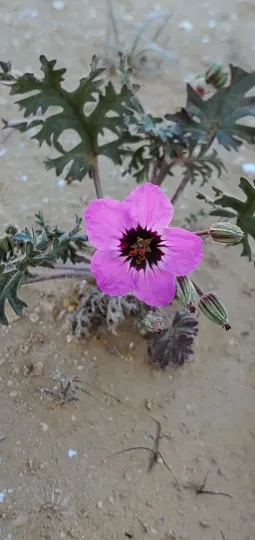
Description
Sowing dates
Erodium crassifolium, commonly known as the thick-leaved stork's bill, is a perennial herb belonging to the Geraniaceae family. Due to its adaptation to arid environments, the sowing period is typically aligned with the onset of the mild season or early spring to maximize the use of available moisture.
Proper soil preparation is essential, as the seeds require a firm, moist seedbed to germinate effectively. The recommended planting depth is shallow, usually ranging from 1 to 2 centimeters, to prevent the delicate seedlings from exhausting their energy reserves before reaching the surface.
Seed spacing should be calculated based on the intended use, whether for cover crop purposes or as forage. Row spacing of approximately 30 centimeters provides sufficient room for plant development while allowing for efficient weed management during the establishment phase.
Early stage growth is characterized by a slow initial pace. Therefore, it is crucial to keep the plots free from aggressive weeds that could quickly outcompete the young seedlings for light, space, and limited soil nutrients.
In regions with fluctuating temperatures, sowing should be timed to avoid frost. Stable soil temperatures of at least 12 degrees Celsius are ideal for promoting steady germination and robust early root development.
Growing requirements
This species is highly tolerant of drought and prefers full sun exposure. It thrives in semi-arid and steppe climates where solar radiation is high, making it an excellent candidate for regions where water resources are restricted.
The plant requires well-drained, porous soils, such as sandy loams or calcareous soils. It is highly sensitive to waterlogging, which can lead to rapid root decay; therefore, heavy clay soils or depressions prone to flooding should be strictly avoided.
Erodium crassifolium grows best in soils with a neutral to slightly alkaline pH. While it is hardy and can survive in nutrient-poor environments, small applications of phosphorus-based fertilizers can significantly boost initial establishment and root system growth.
The optimal temperature range for active vegetation is between 20 and 28 degrees Celsius. The plant has evolved physiological mechanisms to reduce water loss, including thick, often pubescent leaves that reflect heat and minimize transpiration.
Maintenance requirements are minimal once the plant is established. As a drought-adapted species, it is resilient to extreme heat and does not require regular irrigation, making it a sustainable option for low-input agricultural systems.
Yield
In agricultural settings, Erodium crassifolium is primarily utilized as a forage crop in dryland farming. Its ability to remain nutritious even under heat stress provides a vital food source for livestock during periods when conventional grasses may become dormant or desiccate.
The total yield of green biomass depends heavily on seasonal rainfall patterns. While it may not match the massive output of highly fertilized commercial grasses, its stability and survival rate in marginal lands offer consistent economic value to pastoralists.
Seed production is another important aspect of its cultivation. Since the plant is naturally prolific, managed seed harvesting can provide a valuable resource for future planting or for use in ecological restoration projects aimed at stabilizing loose soils.
The plant's root system acts as a natural soil conditioner, helping to bind particles and improve soil structure in degraded arid regions. This secondary benefit adds value beyond simple biomass production, promoting long-term land health.
Effective biomass management requires identifying the peak growth phase. Harvesting before the plant reaches full maturity can optimize the quality of the forage, ensuring better nutrient availability for animals.
Main diseases and pests
Erodium crassifolium possesses a strong natural resistance to most common field crop diseases. Its evolutionary history in harsh conditions has favored the development of robust immune responses, making it relatively immune to many pathogens.
The primary threats to the crop are fungal infections brought on by poor ventilation or excessive moisture. Avoiding water accumulation and ensuring adequate air circulation around the plants are the most effective preventive measures against root and stem rot.
Insect pests such as aphids might appear during the early growth stages, but they rarely cause economic damage. In most cases, natural predators are sufficient to keep pest populations at low levels without the need for synthetic chemical intervention.
Weeds represent the most significant threat during the germination and establishment phases. If left unchecked, competitive vegetation can overwhelm the crop, necessitating proactive cultivation or manual weeding to protect the stand.
Proper density management is crucial to mitigate these risks. Over-crowding plants can increase the relative humidity within the crop canopy, which may trigger localized issues with mildew or pathogenic growth during humid periods.
Harvesting
Harvesting Erodium crassifolium requires careful timing. For forage, the optimal time is during the peak flowering phase, when the concentration of nutrients in the biomass is at its highest, before the plant allocates too much energy to seed production.
When harvesting seeds, extreme caution is needed due to the plant's natural dehiscence mechanism—the seeds are designed to eject forcefully when dry. Collecting the seed pods just before they fully ripen and crack is essential to minimize yield loss.
Post-harvest management involves rapid drying to maintain the quality of the green matter. Air-drying under controlled conditions prevents mold and preserves the plant's nutritional composition, which is vital for later use.
Storage should be conducted in dry, well-ventilated areas to protect the harvested material from humidity-induced decay. Maintaining low moisture content throughout the storage phase is critical for long-term viability.
After the harvest, light surface tillage can help incorporate remaining seeds into the soil, promoting natural regeneration and ensuring the continuity of the stand for the following growing season.