
Argentine fleabane
Erigeron bonariensis L.
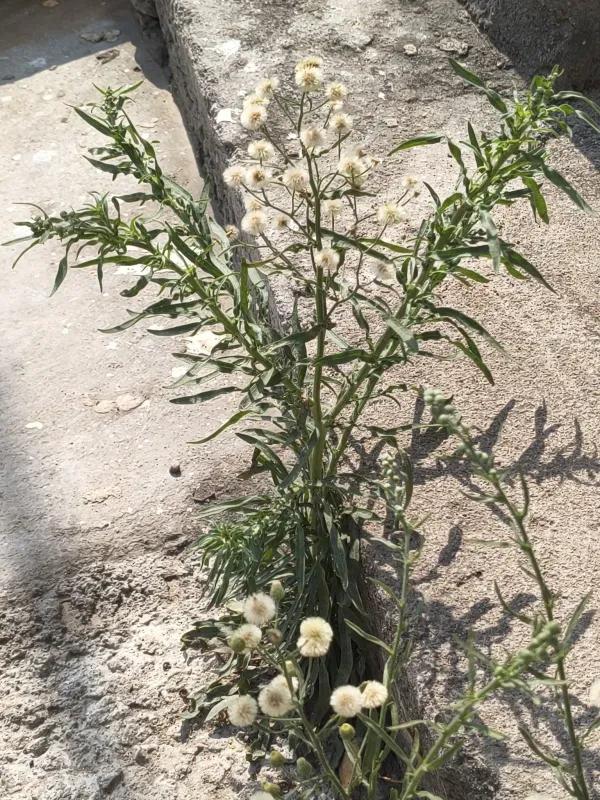
Description
Growing requirements
Argentine fleabane (Erigeron bonariensis) is a member of the Asteraceae family and is recognized as a significant agricultural weed worldwide. Originating from South America, this species has successfully colonized diverse environments, ranging from cultivated fields to disturbed urban areas.
Botanically, it is an annual or short-lived perennial herb that grows from 30 to 100 cm tall. The leaves are narrow and covered in fine hairs, a trait that enhances its drought tolerance. Its flowers are produced in dense panicles, each containing many tiny seeds that are easily dispersed by wind, ensuring rapid colonization of new habitats.
The plant demonstrates extreme adaptability to various soil types, preferring well-drained loamy soils but thriving in poor, sandy, or compacted substrates. It does not require high levels of soil nutrients and can establish itself in areas where other vegetation struggles to survive.
It thrives in full sunlight and is highly sensitive to shade, which limits its growth in dense canopy areas. However, its tolerance to high temperatures and water-scarce conditions makes it a formidable competitor in regions with Mediterranean or temperate climates.
From an agricultural perspective, Erigeron bonariensis is considered a pest. It consumes essential soil nutrients and water, reduces crop yields, and poses a threat to biodiversity. Farmers must implement rigorous management strategies to prevent its spread in agricultural lands.
Main diseases and pests
While the plant is hardy, it can be susceptible to fungal diseases such as downy mildew during periods of excessive rainfall, though this rarely kills the plant.
Generalist insects, including various aphids and plant bugs, may feed on its leaves and stems, but these interactions typically have a negligible impact on the overall population density of the weed.
A significant challenge in managing this species is its confirmed resistance to glyphosate-based herbicides in many agricultural regions, requiring the use of alternative chemical modes of action.
Integrated weed management, including timely tillage and the use of competitive cover crops, is essential to suppressing the germination of new seeds in the soil bank.
Regular monitoring of fields and rapid removal of isolated plants before they reach the flowering stage are critical to preventing the massive seed dispersal associated with this species.