
Echeveria prolifica
Echeveria prolifica Moran & J. Meyran
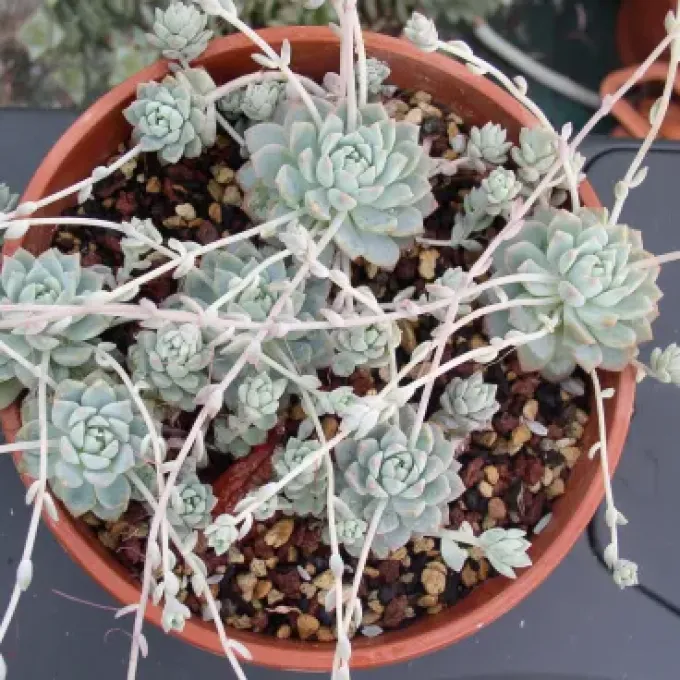
Description
Growing requirements
Echeveria prolifica is a popular succulent species belonging to the Crassulaceae family. Native to the mountainous regions of Puebla and Veracruz, Mexico, this plant is well-known for its prolific growth habit and small, tight rosettes.
The culture requires high levels of light to maintain its compact form. Indoors, placing it on a sunny south-facing window or providing supplemental LED lighting is recommended to prevent etiolation.
Well-draining substrate is critical for this species. A professional mix should consist of succulent-specific potting soil amended with coarse sand, pumice, or perlite to ensure fast drainage and prevent waterlogging.
Watering practices must follow the soak-and-dry method. During the active growing season in spring and summer, allow the soil to dry out completely before watering again, ensuring the water does not pool in the rosette center.
Temperature management involves keeping the plant in a range of 15°C to 25°C during the day. During the winter dormancy period, cooler temperatures around 10°C help simulate its natural environment and encourage better flowering.
Main diseases and pests
Root rot is the most significant agronomic threat to Echeveria prolifica. It is primarily caused by poor drainage, overly heavy soil, or excessive watering during the winter dormant phase.
Mealybugs are common pests that colonize the base of the leaves and the junction of the stem. Their presence manifests as white, cotton-like masses, which can stunt plant growth and attract secondary fungal infections.
Spider mites may occur in low-humidity environments. They cause stippling and disfigurement of the foliage, often appearing as tiny yellow spots on the surface of the succulent leaves.
Integrated pest management involves physical removal of pests using isopropyl alcohol and application of systemic insecticides if the infestation persists. Maintaining clean growing conditions is essential.
Mechanical damage can occur if the leaves are handled roughly, as they are quite brittle. Always use clean tools during propagation or repotting to prevent the transmission of pathogens into the leaf tissues.