
Echeveria paniculata
Echeveria paniculata A. Gray
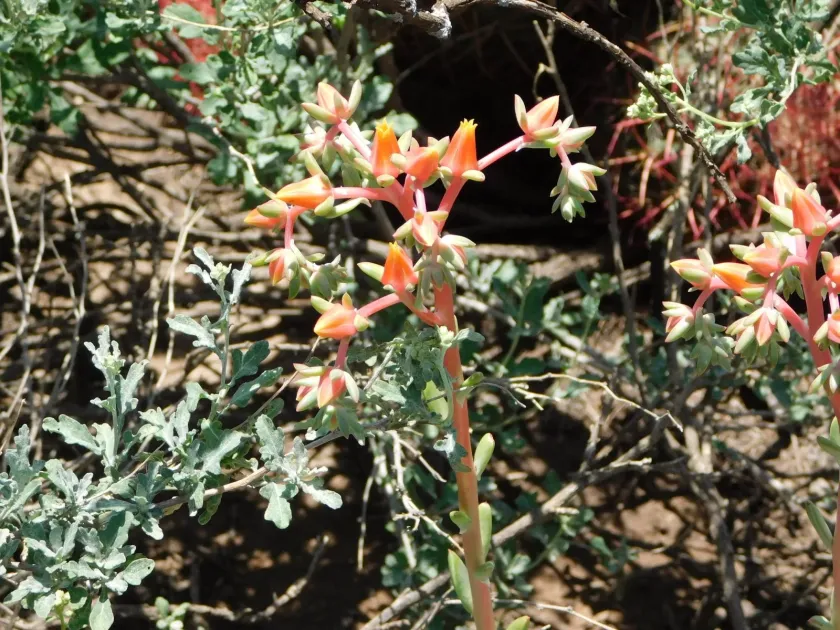
Description
Growing requirements
Echeveria paniculata belongs to the Crassulaceae family and is recognized as a distinctive succulent species. It forms compact rosettes of fleshy leaves that serve as water storage organs, allowing the plant to survive in arid environments.
Native to the Americas, this species is naturally adapted to rocky and sandy terrain with minimal rainfall. In cultivation, it is prized for its architectural form and suitability for xeriscaping or indoor pot gardening.
The plant requires high levels of solar radiation to maintain its dense rosette shape. In indoor conditions, placing the plant on a south-facing windowsill is essential for optimal growth throughout the active season.
A well-draining substrate is critical; a mix of loam, grit, and perlite is recommended. The container must have sufficient drainage holes to prevent water accumulation, which is detrimental to the plant's health.
Temperature management should mimic its native habitat, with warm days and cooler nights. During winter, keeping the plant at lower temperatures facilitates dormancy, preventing premature etiolation and stress.
Main diseases and pests
Root rot is the primary physiological threat caused by overwatering or poor drainage. Once the roots are compromised, the structural integrity of the plant rapidly declines, often leading to irreversible damage.
Mealybugs are frequent pests that colonize the axils of the leaves. These insects feed on plant sap and can be controlled by targeted application of neem oil or specific systemic insecticides.
Spider mites may manifest in low-humidity environments, leading to unsightly webbing and leaf tissue destruction. Increasing humidity or regular misting of the surrounding air can help prevent infestations.
Root aphids pose a significant challenge by attacking the subterranean parts of the plant. Detection requires periodic root inspection, followed by repotting in sterilized soil if an infestation is confirmed.
Preventive maintenance involves strictly regulating watering frequency and ensuring good air circulation around the rosettes. Avoiding contact between the leaves and wet soil is a fundamental rule to prevent fungal pathogen entry.