
Echeveria laui
Echeveria laui Moran & J. Meyrán
Description
Growing requirements
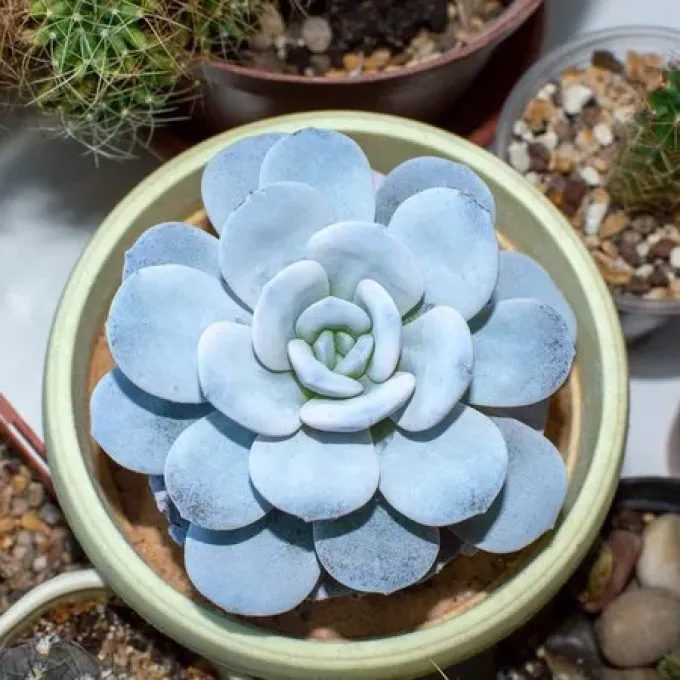
Echeveria laui is a highly prized succulent belonging to the Crassulaceae family, native to the limestone cliffs of Oaxaca, Mexico. It is renowned for its symmetrical, pale blue-white rosettes covered in a heavy, protective farina layer.
Successful cultivation requires intense but diffused light. High light levels are necessary to maintain the tight, compact structure of the rosette, though direct sunlight during peak hours can scorch the foliage.
The substrate must be highly inorganic and porous. A mixture of pumice, perlite, and coarse sand with a minimal amount of organic matter is recommended to facilitate rapid drainage and prevent water accumulation around the roots.
Watering protocols must be strictly controlled. Due to the delicate farina, overhead watering should be avoided at all costs, as even minor moisture droplets can cause permanent scarring on the leaves.
Optimal growth occurs in environments with good airflow and moderate temperatures. The plant enters a dormant phase in winter, during which water intake should be almost entirely restricted to prevent root rot.
Main diseases and pests
The primary threat to Echeveria laui is excessive moisture, which inevitably leads to fungal pathogens and root decay. Overwatering is the most common cause of failure in agricultural production of this species.
Mealybugs are a significant pest, often hiding deep within the leaf folds. Because the plant's white powder mimics the appearance of mealybug secretions, detection often occurs only after an infestation has become severe.
Root aphids pose a hidden danger, targeting the root system and stunting the plant's growth. Growers should perform periodic inspections of the root zone if the rosette stops developing for an extended period.
Fungal infections of the crown can occur if the plant is exposed to high humidity and poor ventilation. Ensuring a constant flow of fresh air is a critical agricultural practice to mitigate this risk.
For pest control, chemical applications must be approached with extreme caution, as many liquid insecticides contain solvents that can strip the farina, leaving the plant vulnerable to sun damage and dehydration.