
Echeveria coccinea
Echeveria coccinea (Cav.) DC.
Description
Growing requirements
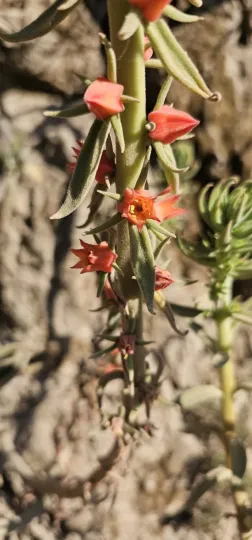
Echeveria coccinea is a perennial succulent belonging to the Crassulaceae family. Unlike many other low-growing Echeveria species, this plant is notable for its upright, woody stems that can reach significant heights, providing a distinct architectural form.
Native to the mountains of Mexico, this species has adapted to arid rocky slopes. Its leaves are covered in fine hairs, giving the plant a velvety texture that helps in moisture regulation and protection from intense UV radiation in its natural habitat.
For successful cultivation, a well-draining soil mix is mandatory. A combination of coarse sand, pumice, and organic potting soil in a 2:1:1 ratio is ideal to ensure that roots do not remain waterlogged, which is the primary cause of plant loss.
Light requirements are high; the plant needs bright, indirect to direct sunlight to maintain its color and compact growth. Insufficient light will cause the plant to etiolate, resulting in long, weak stems and loss of the characteristic rosette form.
Temperature management should follow seasonal cycles, with warmer temperatures (20–28°C) during the active growing season and cooler, dry conditions (10–15°C) during winter dormancy. This cycle is essential for stimulating flower production.
Main diseases and pests
Fungal rots, specifically stem and root rot, are the most significant threats to Echeveria coccinea. These occur primarily due to poor drainage or excessive watering during cold months, leading to the rapid decay of succulent tissues.
Mealybugs are the most common pest found in commercial and private collections. They thrive in the crevices between leaves, where they feed on plant sap and secrete a waxy substance that attracts secondary fungal pathogens.
Root mealybugs present a hidden danger by attacking the roots below the surface. Monitoring for stunted growth or sudden wilting is crucial, as these symptoms often indicate a systemic infestation that requires immediate repotting.
Spider mites can become a problem in low-humidity environments, especially when plants are kept indoors. They pierce the epidermis to feed, leaving visible necrotic spots and weakening the plant structure over time.
Preventive measures include keeping the greenhouse or indoor area well-ventilated, isolating new plants for quarantine, and performing regular inspections of the leaf undersides to detect pest activity at an early stage.