
Echeveria agavoides hybrid
Echeveria agavoides x Echeveria nodulosa
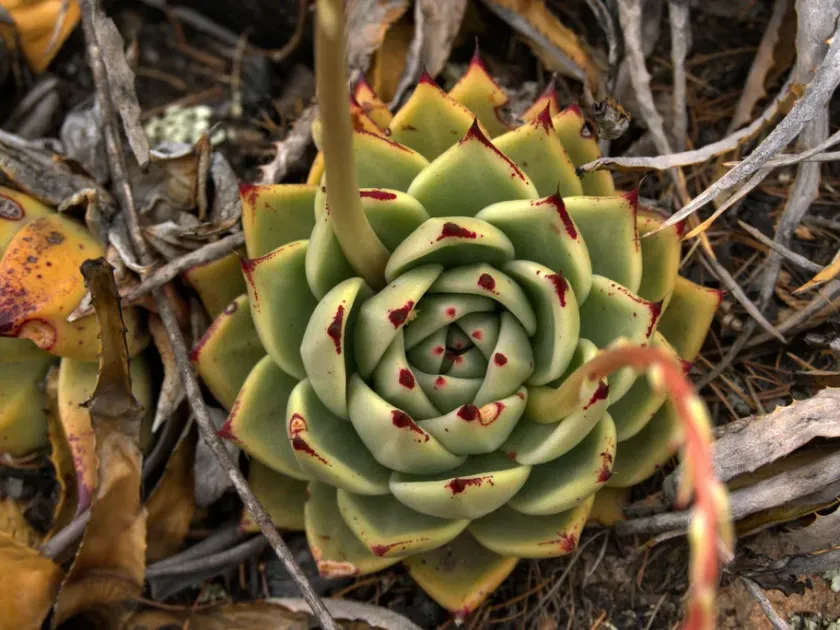
Description
Growing requirements
This hybrid belongs to the Crassulaceae family and is highly prized in horticulture for its structural rosette and attractive coloration inherited from its parent species.
Native to arid regions of Mexico, this succulent requires bright, indirect to direct sunlight to maintain its characteristic compact shape and vibrant leaf pigments.
The substrate must be highly porous and inorganic. A well-draining succulent mix, often consisting of pumice, coarse sand, and a small amount of peat, is vital for plant health.
Watering requirements follow the soak-and-dry method, where the soil is allowed to dry out completely between sessions to mimic the natural drought cycles of the native environment.
Temperature management is key; the plant performs best in a range of 20°C to 25°C during the growing season, with a slight cooling period in winter to stimulate development.
Main diseases and pests
The primary threat to this cultivar is excessive irrigation combined with poor drainage, which inevitably leads to root rot and collar rot.
Common pests include mealybugs, which tend to nestle deep within the tight leaf rosettes, making them difficult to detect without careful inspection.
Spider mites can also attack the plant during periods of extremely low humidity, causing stippling or discoloration on the surface of the leaves.
Bacterial infections may occur if leaves are damaged or kept consistently wet, leading to black, mushy spots that spread quickly through the plant tissue.
To prevent these issues, it is recommended to keep the foliage dry during watering and ensure the potting area has good ambient ventilation.