
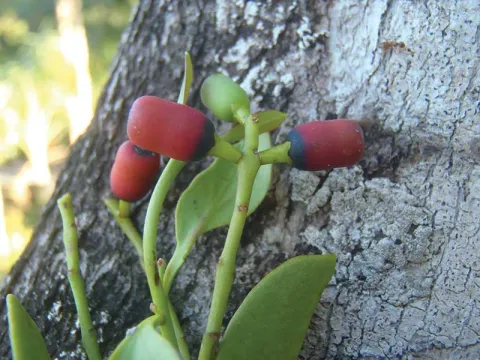
Dendropemon
Dendropemon
Dendropemon is a genus of hemiparasitic plants belonging to the family Loranthaceae. These plants have evolved to survive as epiphytes, attaching themselves to the branches of host trees to extract essential water and mineral nutrients.
What the section contains

Dendropemon
Native primarily to the Caribbean and specific parts of the American tropics, these plants thrive in environments with consistent humidity. Their life cycle is deeply intertwined with the architectural complexity of tropical forests.
The core requirement for Dendropemon is a suitable host tree. The plant uses specialized structures called haustoria to penetrate the host's xylem, establishing a permanent physiological connection for the duration of its life.
Although these plants perform photosynthesis, they rely heavily on the host for resources. Consequently, light exposure in the upper canopy is crucial for maintaining their metabolic processes and reproductive cycle.
The climate must be tropical or subtropical, providing sufficient moisture for the seeds to germinate on bark. The chemical composition of the host bark often determines the rate of success for seedling establishment.
The primary threats to the species itself are deforestation and the removal of host tree populations. Since Dendropemon is an obligate parasite on woody hosts, any reduction in forest canopy directly limits its viable habitat.
In agricultural settings, Dendropemon acts as a pest. It can significantly weaken fruit-bearing trees, such as coffee or citrus species, leading to a decline in overall tree vigor and decreased agricultural productivity.
Birds play a double-edged role: they are necessary for seed dispersal but also contribute to the spread of the plant to new, healthy trees. Managing their presence near sensitive plantations is a constant challenge for farmers.
Secondary infections often occur at the site of the haustorial penetration. Fungal pathogens can exploit the weakened tissue of the host tree, creating complex disease scenarios that threaten both the host and the parasite.
Control strategies are primarily mechanical. Agronomists recommend the periodic pruning of infested branches. It is essential to remove the entire haustorial system to prevent the plant from regenerating from any leftover tissue.