
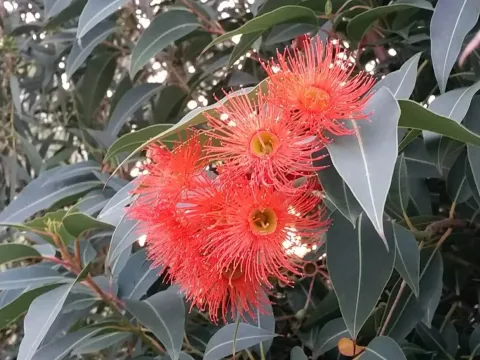
Corymbia
Corymbia
Corymbia is a genus of evergreen trees belonging to the Myrtaceae family. Historically, these species were classified as part of the Eucalyptus genus, but they have been reclassified based on their distinct flowering structures and fruit morphology.
What the section contains
 Corymbia calophylla
Corymbia calophylla
Corymbia calophylla
 Corymbia confertiflora
Corymbia confertiflora
Corymbia confertiflora
 Corymbia grandifolia
Corymbia grandifolia
Corymbia grandifolia
 Corymbia henryi
Corymbia henryi
Corymbia henryi
 Corymbia hybrids
Corymbia hybrids
Corymbia hybrids
 Corymbia intermedia
Corymbia intermedia
Corymbia intermedia
 Corymbia tessellaris
Corymbia tessellaris
Corymbia tessellaris
 Corymbia torelliana
Corymbia torelliana
Corymbia torelliana
 Red bloodwood
Corymbia gummifera
Red bloodwood
Corymbia gummifera
 Spotted gum
Corymbia variegata
Spotted gum
Corymbia variegata
Corymbia
Native to Australia, the distribution of this genus spans a wide range of habitats, from tropical rainforests to savanna woodlands. The species thrive in environments where climatic conditions remain temperate to tropical year-round.
Cultivation requires significant solar exposure, as Corymbia species are strictly heliophilic. High light intensity is crucial for achieving optimal growth rates and ensuring proper development of the tree canopy in plantation settings.
Soil requirements typically involve well-drained loamy or sandy substrates. While the trees exhibit resilience to nutrient-poor soils, they do not tolerate waterlogged conditions, which can lead to rapid decay of the root system.
Economically, Corymbia is highly valued for its durable and strong timber, which is suitable for construction and high-quality woodwork. Furthermore, the foliage contains essential oils, making the trees a subject of interest in pharmaceutical and cosmetic industries.
Leaf spot diseases are among the most common threats to Corymbia plantations, especially in high-humidity climates. Maintaining spacing between trees to encourage airflow is an essential management practice to reduce fungal pressure.
Insect pests, including various leaf-eating beetles and wood-boring insects, represent significant threats to both young saplings and mature trees. Integrated pest management protocols are recommended to mitigate economic damage.
Root rot caused by Phytophthora species can occur if the drainage in the plantation site is inadequate. Ensuring that the site is properly graded and avoiding irrigation water accumulation are critical preventative measures.
Termites are known to cause damage to the wood of mature trees in certain tropical and subtropical regions. Regular monitoring of the trunk health and soil conditions helps in the early detection and management of infestations.
Effective management also involves balanced nutrient application to strengthen the trees' natural defenses. Healthy, well-nourished trees are significantly more resistant to outbreaks of pathogens and insect attacks.