
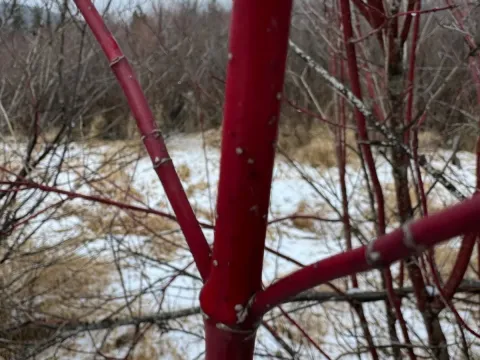
Dogwood
Cornus L.
Dogwood (Cornus L.) is a genus of woody plants belonging to the Cornaceae family. These plants are widely valued for their ornamental features, including unique bark color, flowers, and fruits, across various temperate regions.
What the section contains
 Chinese Kousa Dogwood
Cornus kousa Hance subsp. chinensis (Osborn) Q. Y. Xiang
Chinese Kousa Dogwood
Cornus kousa Hance subsp. chinensis (Osborn) Q. Y. Xiang
 Common dogwood
Cornus sanguinea L.
Common dogwood
Cornus sanguinea L.
 Cornelian cherry
Cornus mas L.
Cornelian cherry
Cornus mas L.
 Cornelian cherry
Cornus officinalis Siebold & Zucc.
Cornelian cherry
Cornus officinalis Siebold & Zucc.
 Cornus elliptica
 (Pojark.) Q. Y. Xiang & Boufford
Cornus elliptica
Cornus elliptica (Pojark.) Q. Y. Xiang & Boufford
 Elwin Orton dogwood
Cornus x elwinortonii T. Molnar & Struwe
Elwin Orton dogwood
Cornus x elwinortonii T. Molnar & Struwe
 Flowering dogwood
Cornus florida L.
Flowering dogwood
Cornus florida L.
 Giant dogwood
Cornus controversa Hemsl.
Giant dogwood
Cornus controversa Hemsl.
 Himalayan strawberry tree
Cornus capitata Wall.
Himalayan strawberry tree
Cornus capitata Wall.
 Hong Kong dogwood
Cornus hongkongensis Hemsl.
Hybrid Dogwood
Cornus hongkongensis x Cornus kousa
Hybrid Himalayan Dogwood
Cornus capitata Wall. x Cornus kousa Burger ex Hance
Hong Kong dogwood
Cornus hongkongensis Hemsl.
Hybrid Dogwood
Cornus hongkongensis x Cornus kousa
Hybrid Himalayan Dogwood
Cornus capitata Wall. x Cornus kousa Burger ex Hance
 Hybrid of Cornus officinalis and Cornus mas
Hybrids between Cornus officinalis Siebold & Zucc. and C. mas L.
Kousa dogwood
Cornus kousa Burger ex Hance
Hybrid of Cornus officinalis and Cornus mas
Hybrids between Cornus officinalis Siebold & Zucc. and C. mas L.
Kousa dogwood
Cornus kousa Burger ex Hance
 Pacific Dogwood
Cornus nuttallii Audubon
Pacific Dogwood
Cornus nuttallii Audubon
 Pagoda dogwood
Cornus alternifolia L. f.
Red osier dogwood
Cornus sericea L. subsp. sericea
Pagoda dogwood
Cornus alternifolia L. f.
Red osier dogwood
Cornus sericea L. subsp. sericea
 Red-barked dogwood
Cornus alba L.
Redosier dogwood
Cornus sericea L.
Red-barked dogwood
Cornus alba L.
Redosier dogwood
Cornus sericea L.
 Roughleaf dogwood
Cornus drummondii C. A. Mey.
Roughleaf dogwood
Cornus drummondii C. A. Mey.
 Rutgers Dogwood
Cornus x rutgersensis T. Molnar & Struwe
Rutgers Dogwood
Cornus x rutgersensis T. Molnar & Struwe
 Silky Dogwood
Cornus amomum Mill.
Silky dogwood
Cornus amomum Mill. subsp. obliqua (Raf.) J. S. Wilson
Silky Dogwood
Cornus amomum Mill.
Silky dogwood
Cornus amomum Mill. subsp. obliqua (Raf.) J. S. Wilson
Dogwood
The culture thrives in well-drained, fertile soil with a slightly acidic to neutral pH. It is highly adaptable, though it performs best in locations that receive consistent moisture throughout the growing season.
Cultivation requires careful site selection, as dogwoods generally prefer spots with partial shade or full sun. Protecting the root zone with organic mulch is essential for regulating soil temperature and moisture.
Pruning is a critical agrotechnical practice. Removing older wood encourages the growth of fresh stems, which are often the most colorful and vigorous parts of the plant, especially in species grown for their bark.
Dogwood has diverse agricultural uses, including landscape architecture for screens and hedging, providing habitat for local wildlife, and harvesting fruits from specific species for culinary applications.
Dogwood Anthracnose is a primary fungal threat that affects leaves and twigs. It is characterized by necrotic spots, which can lead to canopy thinning and death of branches if not managed appropriately.
Powdery mildew is another common issue, particularly in humid or stagnant air environments. Increasing air circulation around the plant is the most effective preventative measure against this pathogen.
Pests such as scale insects and borers may attack the trunk and branches. Regular monitoring and the application of horticultural oils or systemic insecticides help in maintaining plant integrity.
Root rot caused by Phytophthora species is a serious risk in poorly drained soils. Farmers must ensure proper soil structure and avoid deep planting to prevent moisture accumulation near the crown.
Integrated pest management (IPM) practices, including proper nutrition and sanitation, remain the most reliable strategy to prevent major disease outbreaks in dogwood plantations.