
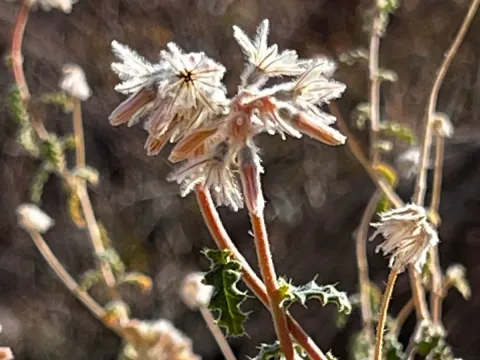
Cevallia
Cevallia
Cevallia is a monotypic genus of flowering plants belonging to the Loasaceae family. The only known species, Cevallia sinuata, is a highly specialized plant native to the arid environments of the southwestern United States and northern Mexico.
What the section contains

Cevallia
This species is well-adapted to extreme desert conditions, thriving in rocky, calcareous, or gravelly soils. Its natural habitat is characterized by low precipitation and high solar radiation, which the plant manages through specific morphological adaptations.
Botanically, Cevallia is defined as a perennial subshrub. It possesses a deep taproot system designed to extract water from significant depths, while its foliage is densely covered in specialized hairs that reduce water loss and protect the tissues from intense heat.
The plant has evolved to withstand high temperature fluctuations and poor soil quality. Its metabolic processes are tuned for survival in nutrient-scarce environments, making it a distinct subject of study for scientists interested in xerophytic physiology and water-use efficiency.
Cultivation of Cevallia requires mimicking its native desert environment. Key factors for successful growth include excellent soil drainage, full sun exposure, and minimal irrigation to prevent root rot. It is primarily managed as a botanical interest or in arid-landscape horticultural settings.