
Bacopa rotundifolia
Bacopa rotundifolia
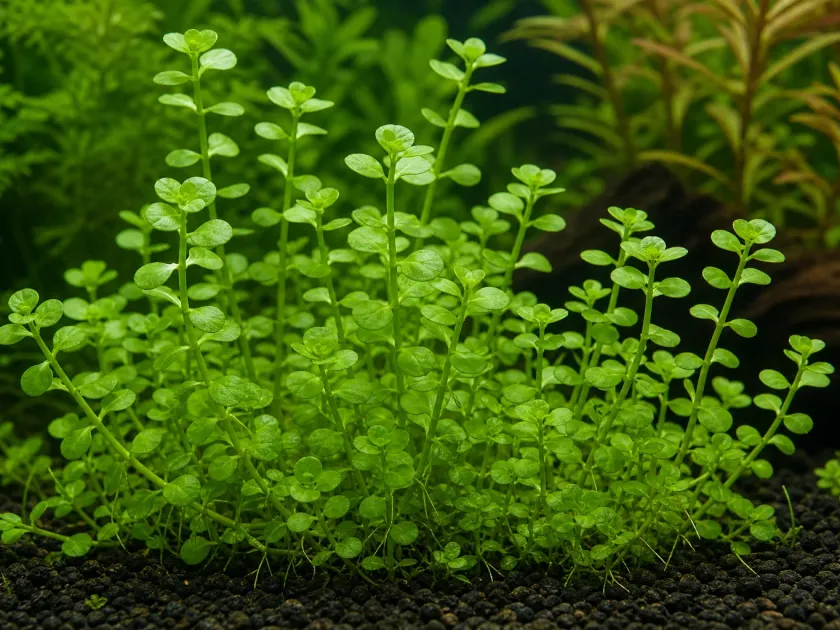
Description
Growing requirements
Bacopa rotundifolia is a perennial herbaceous plant belonging to the Plantaginaceae family. Originally native to the tropical and subtropical regions of North and South America, it thrives in wet, marshy, or aquatic environments.
The plant features succulent, round, light-green leaves arranged in pairs along the stems. Its growth pattern makes it highly desirable for aquatic landscaping where it creates lush, bright foliage clusters.
Optimal cultivation requires high light intensity. When exposed to sufficient light, the plant maintains a compact, dense habit; however, under low-light conditions, it tends to become leggy and loses its lower leaves.
The root system is well-developed and benefits from a nutrient-rich substrate, such as fine river sand or specialized aquatic soil mixes. Regular fertilization with micro-elements is essential to maintain vigorous growth.
The temperature range should be kept between 20°C and 28°C. Stable water parameters, including a pH range of 6.0 to 7.5, are necessary to prevent physiological stress and ensure the longevity of the plant population.
Main diseases and pests
Algal blooms are the most significant threat to Bacopa rotundifolia. Filamentous algae can quickly overgrow the stems, depriving the plant of necessary light and leading to the decay of the foliage.
Bacterial rot, often caused by stagnant water or the accumulation of organic waste, can damage the stems. To prevent this, maintaining good water circulation and cleanliness in the growing area is crucial.
Iron deficiency is a common physiological problem resulting in chlorosis, where the leaves turn pale yellow. Regular supplementation of chelated iron is often required to restore the plant's health.
Pests such as aquatic snails may consume the young, delicate leaves, causing unsightly perforations. Integrated pest management or manual removal of snails is recommended to protect the crop.
Poor water quality, characterized by high levels of organic waste or debris, acts as a primary stress factor. This lowers the plant's immunity and makes it susceptible to opportunistic pathogens and fungal infections.