
Water bacopa
Bacopa aquatica
Description
Growing requirements
Water bacopa (Bacopa aquatica) belongs to the Plantaginaceae family. This species originates from tropical regions of the Americas, thriving primarily in wetlands, marshes, and slow-moving or stagnant water bodies where it forms dense carpets.
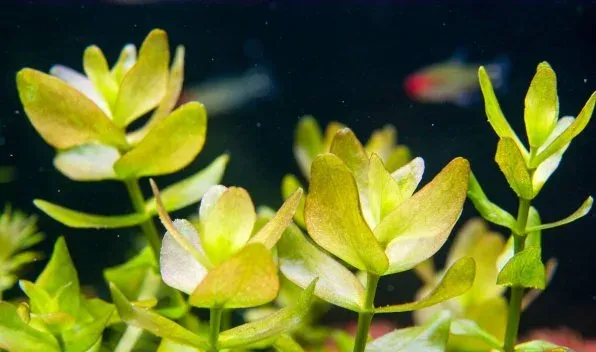
The plant is characterized by its succulent, round-to-oval leaves arranged in opposite pairs along a succulent stem. Depending on the environment, it can grow as an emergent plant in humid swampy areas or as a fully submerged aquatic species in deeper waters.
Cultivation requires specific environmental conditions, with optimal water temperatures between 22 °C and 27 °C. It prefers clean, clear water and is quite sensitive to high levels of waste products, such as nitrates, which can inhibit its development.
Lighting is a fundamental requirement for Bacopa aquatica. To prevent etiolation—where stems become weak and elongated—growers must provide high-intensity light for at least 10 to 12 hours daily. In low light, the plant quickly loses its structural integrity.
Nutrient management involves utilizing a fine-grained, nutrient-rich substrate. Supplementing the water with iron, magnesium, and carbon dioxide is highly recommended to ensure vigorous growth and to maintain the deep green pigment of the leaves.
Main diseases and pests
The most common threat to this culture is the overgrowth of algae on the leaf surfaces, which restricts gas exchange and photosynthesis. This condition is usually a sign of an imbalance in light duration or an excess of fertilizers in the aquatic environment.
Stem rot is a serious disease often triggered by poor water circulation or stagnant conditions. When the stem base starts to soften, the entire plant is at risk, requiring immediate pruning of the healthy top parts to propagate anew.
In semi-aquatic settings, such as paludariums, the plant can be susceptible to spider mites or aphids that target the succulent foliage. Monitoring for these pests is essential, especially when the plant is exposed to air for extended periods.
Chlorosis, or yellowing of the leaves, is a frequent physiological disorder indicating a deficiency of iron or manganese in the growth medium. Regular water chemistry testing helps to identify and rectify these nutrient gaps before permanent damage occurs.
Environmental stress, such as sudden changes in water pH or alkalinity, can lead to leaf melting, where the plant tissue breaks down rapidly. Maintaining stability in all water parameters is the best preventive strategy for long-term cultivation success.