
Aristida setacea
Aristida setacea
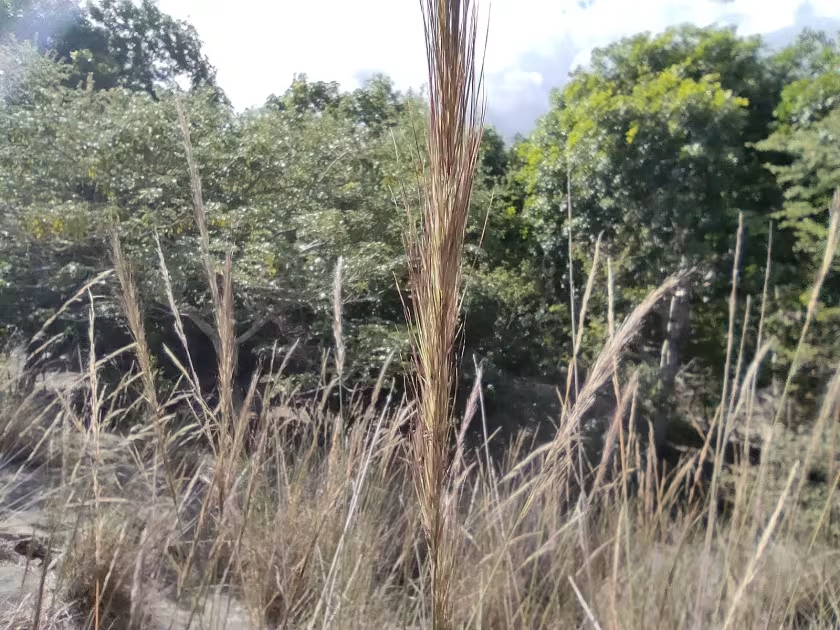
Description
Growing requirements
Aristida setacea, commonly known as a type of wiregrass, is a perennial plant belonging to the Poaceae family. Native to tropical and subtropical Asia, this species has evolved to thrive in environments where water availability is inconsistent and irregular.
The plant is highly drought-tolerant, exhibiting a robust structure that allows it to grow in poor, sandy, or rocky soil conditions. Its resilience makes it a prime candidate for revegetation in dryland climates.
Botanically, Aristida setacea is characterized by a dense tufted habit with narrow, wiry leaves. This morphology is an adaptation to reduce transpiration loss, allowing the plant to sustain growth under intense solar radiation.
The root system is extensive and deep, providing excellent soil anchorage. This feature makes it highly effective for preventing erosion on degraded slopes and stabilizing disturbed landscapes.
It prefers well-drained, sunny locations and is not particularly demanding regarding soil fertility. While it thrives in nutrient-poor conditions, its biomass production can be enhanced with minimal nitrogen application.
Yield
The agricultural value of Aristida setacea is centered on its use as a resilient forage resource. While nutritious during its early vegetative stages, the foliage becomes tough and fibrous as the plant matures, which limits its appeal to livestock.
Farmers often manage this crop by practicing early cutting. Harvesting the biomass before the stalks become too woody ensures better digestibility and higher nutritional retention for animal feed.
In arid regions, it serves as a critical buffer crop, providing grazing opportunities when more palatable, succulent grasses succumb to seasonal drought. Its ability to regenerate after grazing cycles is a notable management benefit.
Beyond forage, the biomass is sometimes processed into rough fiber products or used as a soil cover. Its adaptability makes it a low-input option for large-scale land management in challenging environments.
Overall yields of green biomass are generally moderate but highly reliable compared to more sensitive species, as the plant remains productive under climatic stressors that would otherwise destroy traditional pastures.
Main diseases and pests
Aristida setacea exhibits strong natural immunity against many of the common pathogens that affect agricultural grasses. Its stiff, silicified leaves offer a physical barrier that discourages various bacterial and fungal attacks.
The primary biotic threats include locusts and grasshoppers, which may feed on the foliage during peak infestation years. However, chemical interventions are rarely justified due to the crop’s rugged nature and resilience.
Fungal infections, such as rusts, are uncommon and typically appear only during prolonged periods of excessive humidity or poor field drainage. Standard agronomic practices usually mitigate these risks effectively.
Competition from invasive weeds during the establishment phase is the main challenge for farmers. Once the plant forms a mature, dense stand, it becomes highly competitive and effectively shades out competing species.
Overgrazing remains the most significant management risk. Excessive pressure can deplete the plant’s stored energy reserves, leading to reduced vigour and the long-term degradation of the pasture stand.