
Purple three-awn
Aristida purpurascens
Description
Growing requirements
Purple three-awn (Aristida purpurascens) is a perennial grass species belonging to the family Poaceae. Native to North America, this plant is well-known for its ability to thrive in poor, sandy, and dry soil conditions where many other grasses would fail to establish.
The botanical structure of the plant features tufted stems that grow to a height of 30–80 cm. The leaves are typically narrow and rolled, an adaptation that significantly reduces water loss through transpiration in hot and arid environments.
Regarding environmental requirements, the species favors full sun exposure and well-drained, acidic to neutral soils. It exhibits remarkable drought tolerance, surviving extended dry periods through its deep and fibrous root system.
This grass is rarely cultivated for high-intensity agricultural purposes but is highly valued for environmental restoration. It naturally colonizes disturbed areas, helping to stabilize sandy substrates and prevent wind erosion.
Successful establishment of Aristida purpurascens requires minimal fertilization. Over-fertilization, especially with nitrogen, can negatively impact its natural adaptation to low-nutrient soils and reduce its longevity in a pasture stand.
Harvesting
The agricultural use of purple three-awn is categorized as extensive rather than intensive. It serves as a source of forage for livestock during early growth stages when the foliage is soft and provides essential nutrients.
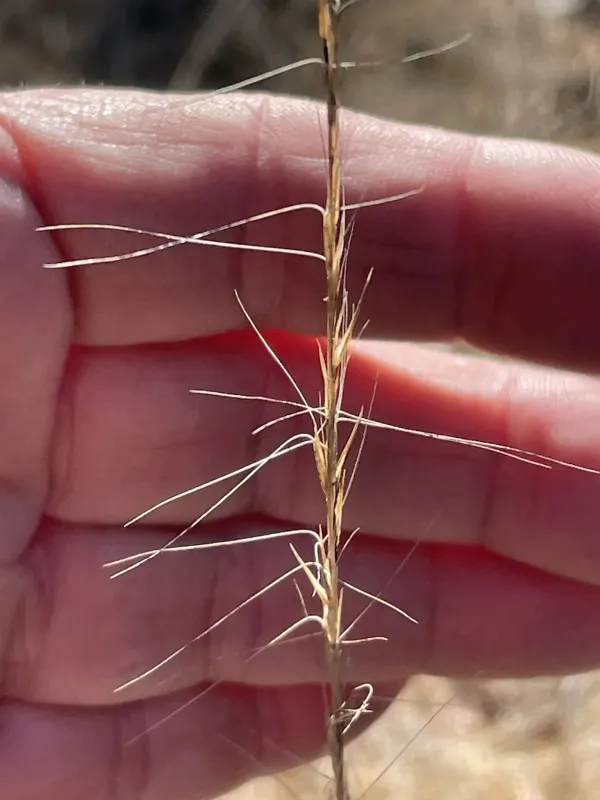
As the plant progresses into the reproductive phase, it develops long, sharp awns. These awns become a mechanical hazard to livestock, potentially causing injury to the mouth and digestive tract if the grass is harvested as hay during late maturity.
To maximize the utility of this grass in pasture management, grazing should be carefully timed. Removing the biomass before the development of sharp seeds ensures that the nutritional value is utilized before the plant becomes unpalatable.
Beyond forage, the plant is primarily utilized for its protective ecological functions. It is highly effective for land reclamation projects and for protecting fragile sandy ecosystems from environmental degradation.
In conclusion, while not a primary hay crop, purple three-awn serves as an important component of sustainable grazing systems in arid climates. Proper management involves periodic grazing or mowing to maintain the plant in its vegetative state.