
Red three-awn
Aristida longiseta
Description
Growing requirements
Red three-awn (Aristida longiseta) is a perennial grass species belonging to the Poaceae family. Native to the western regions of North America, this plant is well-adapted to the harsh environments of arid prairies and semi-desert habitats.
The species is primarily recognized for its exceptional drought tolerance, allowing it to thrive in climates where moisture levels are insufficient for more sensitive crop varieties. It serves as a natural stabilizer for thin, rocky, or sandy soils prone to wind erosion.
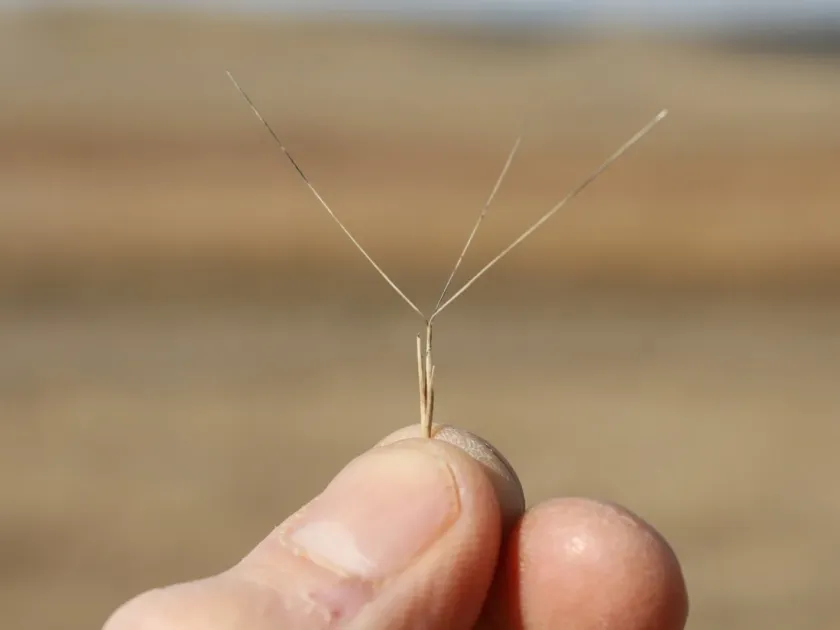
Botanically, the plant features narrow leaves and distinct inflorescences characterized by long, triple-branched awns, which provide it with an evolutionary advantage in seed dispersal across open, windy landscapes.
Cultivation of this grass requires minimal inputs, as it is evolved to survive in nutrient-poor environments. It thrives in full sunlight and well-drained soils, showing limited tolerance for waterlogged or highly fertile agricultural soils where competition from other species is intense.
While not a traditional cash crop, Aristida longiseta plays a critical role in ecological restoration, helping to restore vegetation cover on degraded or abandoned lands where standard agricultural crops would inevitably fail.
Main diseases and pests
The primary concern regarding the use of this grass in livestock management is the mechanical danger posed by its mature awns. When dry, these sharp structures can cause injuries to the eyes, mouths, and skin of grazing animals, significantly reducing the plant's forage value.
The species is remarkably robust and displays a high degree of natural resistance to standard crop diseases, such as rusts or smuts. Its tough, fibrous tissues make it less susceptible to damage compared to softer, more succulent grasses.
There are no significant insect pests that target Aristida longiseta to a degree that necessitates chemical intervention. Its resilience is tied to its slow growth rate and the high content of structural compounds like lignin and silica.
In an agricultural setting, the main threat is the potential for the plant to spread uncontrollably. As a highly adaptive pioneer species, it can easily colonize adjacent crop fields, becoming a persistent and difficult-to-manage weed.
Effective management strategy involves careful monitoring of seed maturation cycles to prevent uncontrolled dispersal into high-production areas, ensuring that the plant remains contained within designated ecological zones.