
Aristida junciformis
Aristida junciformis
Description
Growing requirements
Aristida junciformis is a perennial grass species belonging to the Poaceae family. Native to the southern regions of Africa, this plant is well-known for its extraordinary ability to thrive in harsh environments where more delicate forage crops would typically fail.
This species is highly adapted to nutrient-poor, sandy, or gravelly soils. Its physiological structure allows it to maintain growth during prolonged droughts, making it a valuable asset for extensive agricultural systems in arid zones.
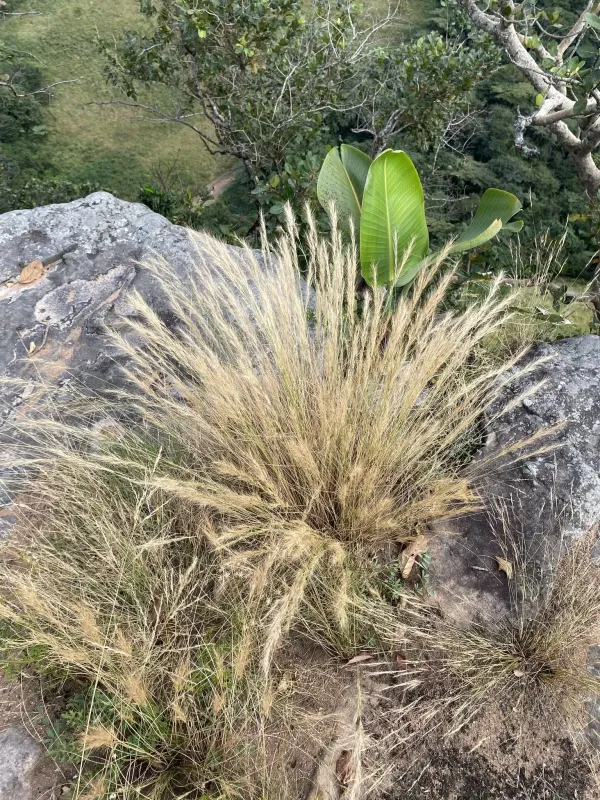
Botanically, the plant forms dense tufts or tussocks. Its leaves are typically rigid and involute, which reduces moisture loss through transpiration. The root system is deep and extensive, enabling the plant to access subsoil moisture effectively.
In terms of climatic requirements, it prefers warm temperatures and is well-adapted to environments prone to regular fires. Its growth points are located close to the soil surface, ensuring rapid regeneration after fire events.
Economically, it is primarily used for grazing livestock. While its nutritional quality is considered moderate to low compared to cultivated grasses, its reliability as a perennial ground cover is a significant factor in semi-arid rangeland management.
Main diseases and pests
The primary threats to this grass include fungal pathogens that typically emerge during unseasonably wet seasons, leading to root rot or leaf spot diseases. Managing soil moisture is key to preventing these outbreaks.
Insect pests such as grasshoppers and locusts pose a recurring threat, as they can consume large amounts of biomass during swarming events. Additionally, soil-dwelling larvae can cause localized damage to the root network.
Excessive nitrogen fertilization often proves detrimental to this species. Because it is evolutionarily adapted to low-fertility soils, high-input agricultural practices can lead to nutrient imbalance and increased plant mortality.
Overgrazing remains the most significant anthropogenic threat. When managed incorrectly, the tussocks are weakened, leading to soil exposure and the subsequent invasion of invasive weed species that displace the native Aristida.
Finally, competition from faster-growing, more aggressive grass species in areas where soil fertility is artificially boosted can cause a decline in the population density of Aristida junciformis over time.