
Argyroderma testiculare
Argyroderma testiculare
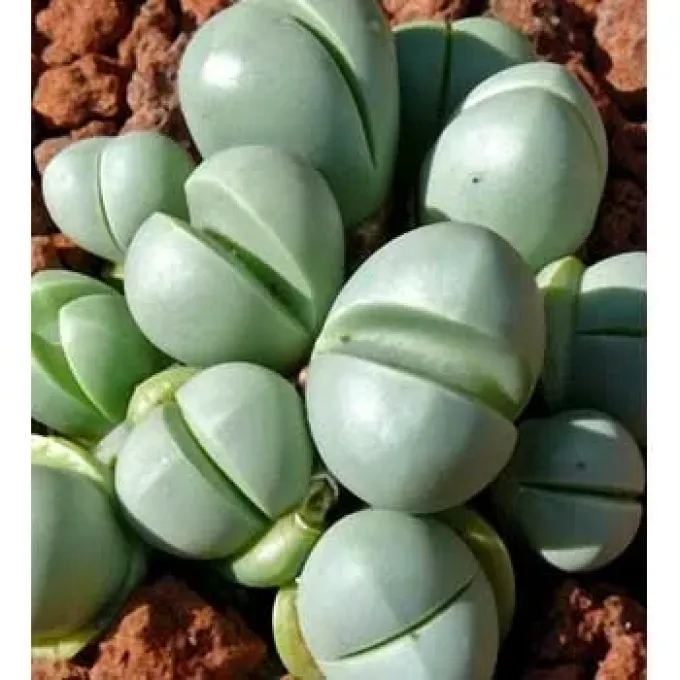
Description
Sowing dates
Sowing Argyroderma testiculare seeds is best performed in the spring when daylight hours start to increase. March or April is considered the optimal time, ensuring enough natural light for healthy seedling development.
For successful germination, seeds are sown in a slightly moist substrate based on sand and peat, without burying them deeply. It is recommended to sprinkle them lightly with fine sand to keep them in place.
Creating greenhouse conditions is a vital requirement: the container must be covered with glass or film to maintain stable high humidity until the first sprouts appear.
After germination, seedlings require gradual acclimatization to dry air, otherwise, the delicate skin of the young plants may rot from excessive moisture.
The transplanting process should not be carried out until at least one year after sowing, as the root system of this species is extremely sensitive to any mechanical damage.
Growing requirements
Argyroderma testiculare belongs to the Aizoaceae family and is a miniature succulent that resembles smooth, silvery sea pebbles.
The plant originates from the arid zones of South Africa, where it has adapted to grow in poor, sandy-stony soils with minimal annual precipitation.
For normal growth, bright but diffused lighting is required, as direct sunlight during midday hours can cause severe burns to the epidermis.
The soil must have excellent drainage capabilities; it is recommended to use mixtures dominated by coarse-grained sand, perlite, and a small amount of turf soil.
During the summer, the temperature should be kept at 20–25 degrees Celsius, while in winter, during the deep dormancy period, the plant needs cool conditions around 10–12 degrees.
Main diseases and pests
The primary threat to the health of this succulent is overwatering, which instantly provokes root rot, leading to the death of the entire plant.
In stagnant air conditions, fungal diseases may occur, manifesting as soft brown spots on the surface of the "leaves."
Among pests, the mealybug poses the greatest danger, as it can hide in the crevices between plant segments and suck the sap from the plant.
The plant can also be attacked by spider mites, especially under conditions of critically low humidity and high room temperature.
For prevention, it is necessary to inspect the plant regularly and strictly follow the watering regime, avoiding moisture in the growth points and folds between the lobes.