
Ardisia coriacea
Ardisia coriacea
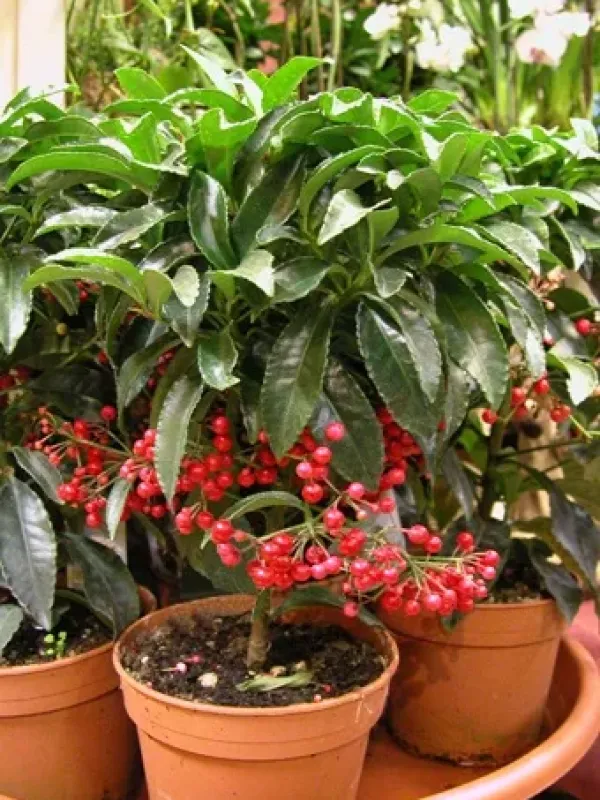
Description
Growing requirements
Ardisia coriacea is an evergreen shrub or small tree belonging to the Primulaceae family. Originally native to tropical regions of Central and South America, it thrives in environments that mimic its natural understory habitat with filtered light and high atmospheric humidity.
The plant requires stable growing conditions with temperatures ranging between 20°C and 25°C. During the winter months, providing a cooling period is essential for successful dormancy, which helps stimulate future flowering and the development of its ornamental berries.
An ideal growth medium must be well-draining, loose, and slightly acidic, with a pH between 5.5 and 6.0. A mixture of peat moss, perlite, and organic compost is recommended to ensure adequate root aeration and moisture retention without risking root rot.
Environmental management involves maintaining air humidity levels above 60%. In greenhouse conditions, misting or automated ultrasonic humidifiers are necessary to prevent the leaves from curling or developing dry, necrotic tips, which reduce the aesthetic quality of the crop.
Agronomic practices include scheduled watering with low-mineral water to avoid salt accumulation in the substrate. Fertilization should be applied during the growing season using a balanced NPK fertilizer with added micronutrients to support healthy leaf development and flowering.
Main diseases and pests
Common pests affecting Ardisia coriacea include scale insects and mealybugs, which tend to congregate in the axils of the leaves. These pests extract sap, leading to weakened growth and the formation of sooty mold on the sticky honeydew secretions left on the foliage.
Spider mites are a significant threat, especially in environments where humidity is poorly controlled. These microscopic pests thrive in dry conditions and can cause extensive damage to the leaf tissue, often appearing as fine webbing between leaves and branches.
Fungal pathogens such as Phytophthora or Rhizoctonia may infect the root system if the soil remains waterlogged for extended periods. Symptoms include wilting and yellowing leaves that fail to respond to standard irrigation management, indicating severe root decay.
Leaf spot diseases, often caused by Colletotrichum or similar fungi, can appear during periods of high humidity and poor ventilation. Regular maintenance, including the removal of fallen debris and dead leaves, is critical to reduce the inoculum load in the greenhouse environment.
Proactive monitoring and the application of integrated pest management (IPM) strategies, including biological controls like predatory mites, are recommended for large-scale operations to minimize chemical usage while maintaining plant vigor and health standards.