
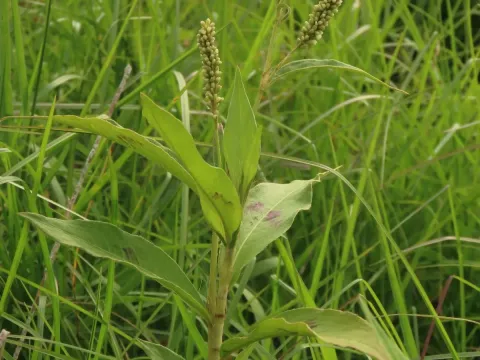
Bearded knotweed
Persicaria barbata
Bearded knotweed (Persicaria barbata) is a member of the Polygonaceae family. It is a perennial or annual herbaceous plant typically found in wet environments.
What the section contains
Bearded knotweed
The plant features erect or ascending stems that can grow significantly. Its leaves are lance-shaped or elliptic, often showing distinctive marginal hairs that give the plant its common name.
Flowers are arranged in dense terminal or axillary racemes. They are small, whitish to pinkish, consistent with the characteristic inflorescence of the Persicaria genus.
It possesses a fibrous root system that provides strong anchorage in saturated soil, allowing it to thrive in paddy fields and wetlands.
Reproduction occurs primarily through seeds, which exhibit high viability and can persist in the soil seed bank for extended periods.
The native range of the species extends across Western Asia, through the Himalayas to India, Sri Lanka, Bangladesh, Indochina, Malaysia, and China.
In addition to its native regions, it has been introduced to Sudan, Malawi, Madagascar, and New Caledonia, where it has successfully established populations.
Bearded knotweed is commonly found in riparian zones, irrigation ditches, and water-logged areas. It is particularly problematic in irrigated agricultural landscapes.
The plant demonstrates a strong preference for damp, nutrient-rich soils, making it a persistent weed in tropical and subtropical rice-growing regions.
Its ability to disperse through water allows it to rapidly colonize new areas, especially after flooding events or changes in local irrigation management.
The primary damage is caused by competition for resources, as the weed quickly suppresses the growth of crops in moist field conditions.
High densities of this weed lead to significant yield losses in rice cultivation by overshadowing young plants and sequestering essential soil nutrients.
The presence of Persicaria barbata facilitates the survival of pests and pathogens that may subsequently infest neighboring crop fields.
It significantly hinders mechanical agricultural operations, as dense stands clog equipment and increase the moisture content of harvested material.
The invasive potential of this plant can lead to the displacement of beneficial native flora, negatively impacting local biodiversity in wetland areas.
Integrated weed management is essential, focusing on preventative measures such as maintaining clean irrigation canals and using certified weed-free seeds.
Deep cultivation and proper soil preparation before planting are effective mechanical methods to reduce the initial weed population.
Strategic water management in paddy fields, such as temporary draining, can suppress the germination and early growth stages of the weed.
- Manual weeding before the onset of the flowering stage to prevent seed set.
- Crop rotation to break the life cycle of the weed in infested paddies.
Chemical control involving selective herbicides is a key component when infestations reach economic threshold levels, ensuring crop safety.