
Bunge's smartweed
Persicaria bungeana
Description
How to tell it apart
Bunge's smartweed (Persicaria bungeana) belongs to the Polygonaceae family. It is an annual herbaceous plant with a stem that grows erect or branched, typically reaching heights between 10 and 60 centimeters.
The leaves are lanceolate or linear-lanceolate in shape, usually ending in a pointed tip. They can be short-petiolate or sessile, often exhibiting a wedge-shaped base.
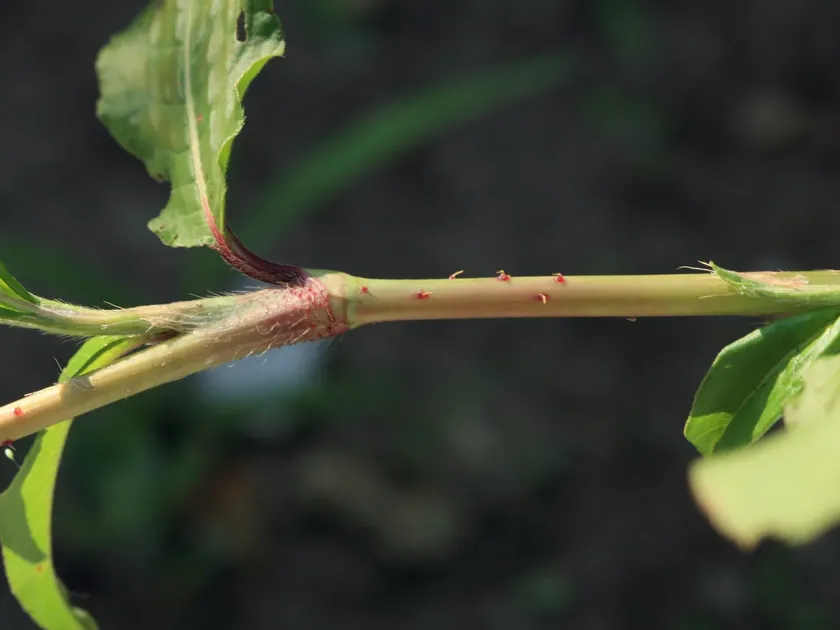
A distinctive feature of this plant is its ocrea (stipular sheath), which is characteristic of the buckwheat family. In this species, the ocrea is covered with noticeable cilia along its edge.
The flowers are very small and arranged in spike-like or panicle-like inflorescences. The perianth typically displays pink or whitish hues, making it easily distinguishable during the flowering phase.
The root system is taproot-based with limited branching, which allows the plant to anchor effectively in moist or loose soil during the early stages of development.
Where it grows
This weed species prefers moist habitats. It is commonly found along the banks of rivers, in floodplains, wet meadows, and various low-lying areas where moisture accumulates.
In agricultural settings, Bunge's smartweed colonizes row crops, cereal fields, and vegetable gardens, especially where soil moisture levels are consistently high.
The plant frequently emerges on disturbed lands or in fields where proper agrotechnical maintenance has been neglected, leading to rapid colonization of the area.
It is widely distributed across temperate and monsoon climate regions, including parts of East Asia, where it adapts to local crop production systems.
Seeds are often dispersed via irrigation channels, which makes it a significant weed problem in irrigated agricultural landscapes and rice paddy systems.
Harm it causes
The primary damage caused by Bunge's smartweed is its strong competitiveness for resources such as water, nutrients, and sunlight, which is especially critical during the seedling stage of crops.
Heavy infestation leads to substantial yield losses, as the weed grows rapidly and creates canopy shade, effectively suppressing the development of the cultivated crop.
The presence of this weed complicates standard field operations, resulting in increased labor costs for manual weeding or higher expenses for chemical herbicide applications.
In addition to competition, the plant can act as a secondary host for various crop pests and fungal pathogens, potentially increasing the disease pressure in the field.
Contamination of the harvested crop with weed seeds reduces its market value and necessitates post-harvest cleaning, which negatively impacts the overall farm profitability.
How to control
Effective control of Bunge's smartweed starts with implementing a sound crop rotation strategy that forces weeds to compete with crops that have different cultivation requirements.
Mechanical destruction, such as deep autumn plowing and timely inter-row cultivation, is highly effective in reducing the seed bank in the topsoil layer.
Managing soil moisture is essential; because this plant is highly moisture-dependent, improving drainage in field areas can significantly reduce its growth and germination rates.
Chemical control involves the use of systemic herbicides. Certain sulfonylurea compounds and other selective herbicides have proven effective in managing this species in various crops.
- Ensure the use of high-quality, weed-free seeds.
- Prioritize early-season cultivation to eliminate weed flushes.
- Apply registered herbicides at the recommended growth stages.
- Maintain weed-free conditions around irrigation ditches and field margins.
Taxonomy
- Latin name
- Persicaria bungeana
- Family
- Гречишные
- EPPO code
- POLBU