
Bohemian knotweed
Reynoutria bohemica
Description
How to tell it apart
Bohemian knotweed (Reynoutria bohemica) is a hybrid perennial plant belonging to the Polygonaceae family. It is a cross between Japanese knotweed and giant knotweed, exhibiting intermediate morphological characteristics.
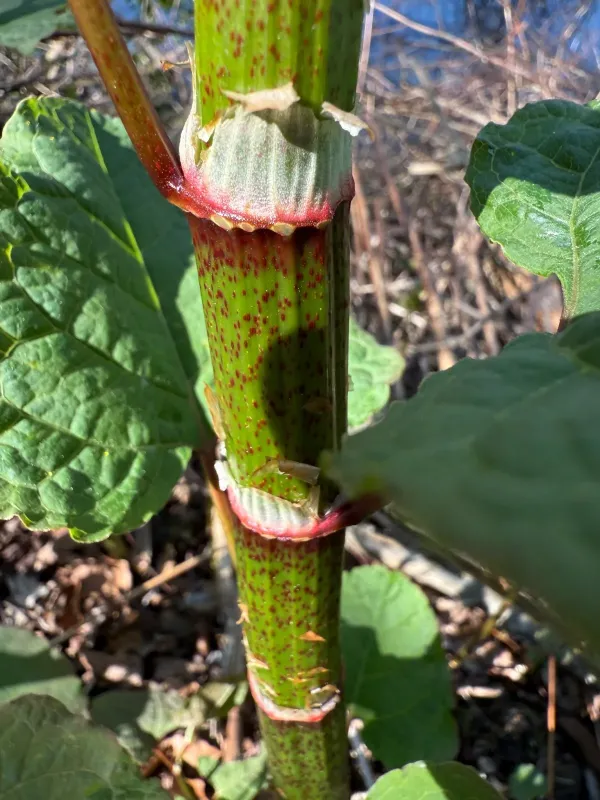
The plant grows into large, dense clumps with hollow, bamboo-like stalks. Stems can reach heights of up to 3 meters, making it one of the most recognizable and aggressive invaders in temperate regions.
Its root system consists of thick, woody rhizomes that can extend deeply into the soil and spread laterally for several meters, allowing the plant to colonize vast areas rapidly.
Leaves are generally heart-shaped to triangular, and the plant produces creamy-white flower clusters in late summer. It reproduces primarily through vegetative means, as stem and root fragments can easily initiate new growth.
The plant is highly adaptive and can thrive in various soil types, although it prefers moist, nutrient-rich environments. Its ability to regenerate from minimal fragments makes it exceptionally difficult to eradicate.
Where it grows
Bohemian knotweed thrives in disturbed environments, particularly along riverbanks, roadsides, and abandoned industrial areas. It frequently colonizes areas where soil has been moved or disrupted by human activity.
In agricultural settings, it can quickly move from adjacent wild areas into fields and pastures. Once established, it acts as a primary invader, forming monocultures that effectively exclude all native or crop species.
It prefers sunny or semi-shaded locations with consistent soil moisture. It is commonly spread by floods, which carry root segments downstream, and by agricultural equipment that transports infested soil to clean areas.
While it avoids extremely arid or nutrient-poor soils, it is remarkably resilient and can persist in degraded landscapes where other plants might struggle to survive.
The presence of this knotweed is often a sign of landscape alteration, as it exploits gaps in the vegetation caused by erosion, construction, or improper land management practices.
Harm it causes
The primary impact of Bohemian knotweed is the total loss of biodiversity. Its dense canopy creates deep shade, preventing light from reaching the soil surface and suppressing the growth of all other plants.
Through allelopathy, the plant releases chemicals into the soil that actively inhibit the germination and growth of neighboring vegetation, facilitating its expansion into new areas.
The extensive root system causes significant physical damage to infrastructure, including building foundations, retaining walls, paved roads, and drainage systems, leading to high maintenance costs.
In farming, it obstructs access to fields and renders land unproductive. Its sheer biomass makes mechanical removal difficult, often requiring specialized equipment and multiple interventions over several seasons.
Furthermore, it disrupts local ecosystems by altering the structure of the soil and water-holding capacity, which can lead to increased erosion risks along riverbanks once the native cover is lost.
How to control
Effective control of Bohemian knotweed requires a long-term management strategy. Mechanical removal alone is rarely sufficient, as even small rhizome fragments left in the ground will cause the plant to resprout.
Systemic herbicides, particularly those based on glyphosate, are the most effective way to address large infestations. Applications are usually most successful when timed correctly to coincide with the plant's translocation of nutrients to the roots.
Integrated management involves repeated mowing or cutting to exhaust the plant's reserves, followed by targeted chemical treatments to finish off the weakened rhizomes.
- Systematic mowing to deplete energy reserves.
- Targeted application of systemic herbicides.
- Excavation of rhizomes with proper disposal.
- Usage of heavy-duty landscape fabrics.
- Strict monitoring and decontamination of machinery.
Persistence is key; a single treatment is never enough. Ongoing monitoring of the site for at least three to five years after initial treatment is necessary to catch and eliminate any emerging sprouts.
Taxonomy
- Latin name
- Reynoutria bohemica
- Family
- Гречишка вьюнковая
- EPPO code
- REYBO