
Bellardi's knotweed
Polygonum bellardii
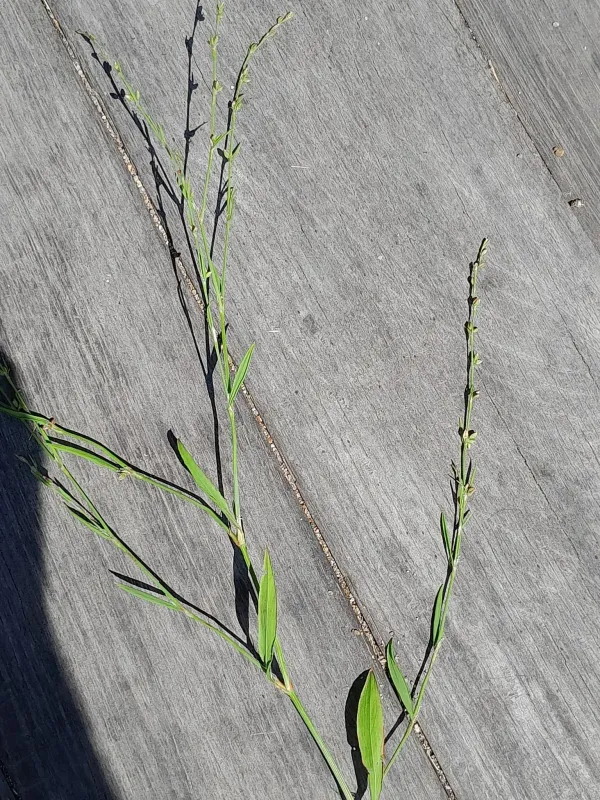
Description
How to tell it apart
Bellardi's knotweed, scientifically known as Polygonum bellardii, is an annual herbaceous weed belonging to the Polygonaceae family. It is recognized for its highly branched stems that can grow in both erect and prostrate forms.
The leaves are alternate, usually lanceolate or elliptic in shape, and typically sessile or with very short petioles. The foliage color ranges from bright green to a grayish-green, depending on soil conditions and moisture availability.
The flowers are small and clustered in the leaf axils, creating spikes that extend along the stems. The perianth is primarily green, often highlighted with thin white or pink margins, serving as a key diagnostic feature.
The seeds of this plant are small, three-angled achenes, generally dark brown to black in color. They are notable for their longevity, capable of remaining viable in the soil for several years before germinating.
Proper identification during the early seedling stage is crucial for farmers, as the weed's morphology changes significantly as it matures, making it harder to distinguish from other knotweed species later in the season.
Where it grows
This weed species thrives in open, sunny environments. It is frequently observed in disturbed areas such as field edges, roadsides, fallow lands, and areas with poorly managed vegetation.
In agricultural settings, Bellardi's knotweed is a persistent problem in row crops and cereal fields. It readily exploits the space between crop rows, especially in systems with inadequate canopy cover or delayed weed management.
The plant demonstrates a remarkable ability to adapt to various soil types, including compacted and nutrient-poor soils. This versatility allows it to colonize diverse landscapes, from intensively managed fields to neglected borders.
Bellardi's knotweed is particularly drought-tolerant, giving it a competitive edge in arid or semi-arid climates where it can persist while other, less adapted weeds fail during dry spells.
Its seeds are easily disseminated by farm machinery, wind, and irrigation water, meaning that primary infestations often start at field entrances and quickly move into the interior if left unchecked.
Harm it causes
The main agricultural impact of Bellardi's knotweed is its fierce competition with crops for limited resources, specifically soil moisture and essential mineral nutrients, which significantly limits crop potential.
Due to its vigorous branching habit, the weed produces substantial above-ground biomass. This foliage provides significant shading to crop seedlings, effectively inhibiting their growth and slowing down the metabolic rate of the cultivated plants.
The presence of this weed interferes with standard field operations. Its entanglement in harvesting equipment can lead to mechanical downtime, reduced harvest speed, and increased wear on agricultural machinery.
Furthermore, dense infestations of Bellardi's knotweed create microclimates within the field canopy that are conducive to the growth of various crop diseases, potentially increasing the pressure of fungal infections.
Beyond physical interference, the weed acts as a host for various insects and pathogens, providing a refuge for pests that can migrate to the crop and cause further economic damage throughout the growing season.
How to control
Effective management begins with mechanical practices such as deep autumn plowing. This technique buries the seeds deep within the soil profile, often preventing germination in the subsequent spring.
Crop rotation remains a fundamental strategy. Integrating crops with dense planting patterns, such as winter cereals or forage grasses, helps shade out the weed and prevents it from establishing a foothold in the field.
Inter-row cultivation is essential in row crops. Performing this operation during the early growth stages of the knotweed is highly effective, as it eliminates the plant before it develops a robust root system and sets seed.
Chemical control involving selective herbicides is a common practice. Success depends on timing; treatments are most effective when the weed is in the seedling or early vegetative rosette phase.
- Utilize high-quality, weed-free seed for planting.
- Clean machinery thoroughly between field shifts to stop seed dispersal.
- Monitor field margins regularly to prevent the spread of infestations.
- Apply tank mixes of herbicides to manage weeds with varying stages of maturity.
Taxonomy
- Latin name
- Polygonum bellardii
- Family
- Гречишка вьюнковая
- EPPO code
- POLBE