

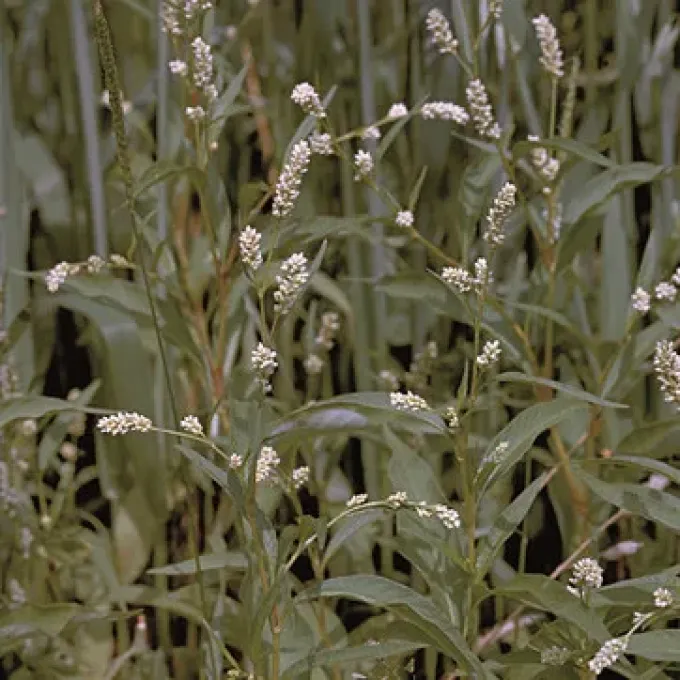
Description
How to tell it apart
Rough knotweed (Polygonum scabrum) is an annual herbaceous weed belonging to the Polygonaceae family. It features a branched, upright stem that can reach up to 1 meter in height.
The leaves are lanceolate and often characterized by a distinctive dark spot on the upper side, which is a key identifying trait for this specific species.
The flowers are arranged in dense spike-like racemes at the ends of branches and leaf axils, displaying small white or pinkish-green petals.
It possesses a strong taproot system, allowing the plant to stabilize itself and compete efficiently for resources in various soil conditions.
The fruit is a shiny, dark-brown nutlet, lens-shaped, which can remain dormant in the soil seed bank for several years before germinating.
Where it grows
This weed is commonly found in agricultural fields, preferring fertile, moisture-retentive soils that are rich in nitrogenous compounds.
It frequently colonizes row crops, vegetable gardens, roadsides, and disturbed areas, serving as a source for spreading seeds into cultivated fields.
Rough knotweed thrives in irrigated areas, where consistent soil moisture promotes its rapid vegetative development and high seed production.
It is particularly problematic in corn, soybean, and sunflower fields where it takes advantage of the spacing between rows to grow unchecked.
The species is widespread in temperate regions and is considered a major nuisance for both conventional and organic farming operations.
Harm it causes
Rough knotweed causes significant economic losses by competing with crops for water, sunlight, and essential soil nutrients throughout the growing season.
Due to its vigorous growth, it creates dense canopy layers that shade out young crop seedlings, significantly reducing their potential yield.
The presence of this weed at harvest time creates mechanical obstacles for machinery and results in high levels of dockage in the harvested grain.
It can act as an alternate host for various plant viruses and insect pests, increasing the risk of infestations in adjacent crop fields.
The high seed output of a single plant contributes to rapid accumulation of weed seeds in the soil, complicating long-term weed management strategies.
How to control
Effective management requires a multi-faceted approach, starting with proactive crop rotation to break the weed's life cycle.
Mechanical control through deep autumn tillage and timely inter-row cultivation is highly recommended to suppress emergence in row crops.
Chemical control involving the application of selective herbicides in the early post-emergence stage is often necessary to prevent economic injury.
Sanitation practices, such as cleaning harvesting equipment and using certified clean seed, are essential to stop the spread of new infestations.
- Strategic use of herbicide mixtures.
- Preventive measures in non-crop areas.
- Integrated weed management programs.
Content graph
Connections · Rough knotweed
Most often together:
Marketplace
Products · 5


Granstar Pro 75
«Дюпон Інтернешнл Оперейшнз Сарл», Швейцарія
Herbicides
0
0
·
61
4 offers
3.47 €per pack
Buy
Biology
Taxonomy
- Latin name
- Polygonum scabrum
- Family
- Прочие
- EPPO code
- POLSC