
Description
How to tell it apart
Pale persicaria (Persicaria lapathifolia), also known as spotted knotweed, belongs to the Polygonaceae family. It is an annual weed that is highly adaptable to various environmental conditions.
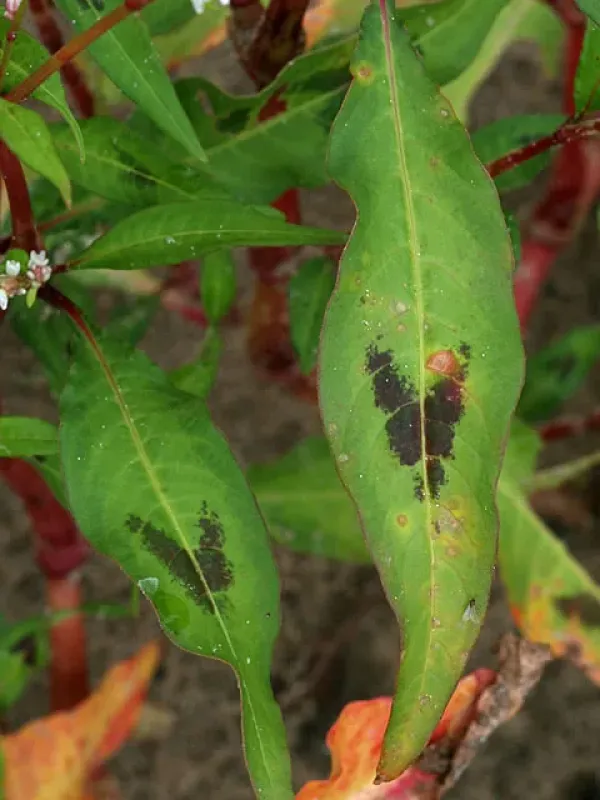
The plant features a branching stem that can reach heights of 20 to 80 cm. The lanceolate leaves often display a dark spot in the middle, which is a common diagnostic feature for this species.
The flowers are arranged in dense spikes that are usually pinkish or whitish. The flowering period is extended, allowing the plant to produce a significant amount of seeds over the summer.
The root system is primarily a taproot, which helps the plant establish itself in various soil types, particularly in moist and compacted environments.
Seeds are small, dark brown, and rounded. They are known for their longevity in the soil seed bank, making the weed a persistent problem in long-term agricultural planning.
Where it grows
This weed thrives in moist and fertile soils. It is frequently observed in riparian zones, wetlands, ditches, and agricultural fields with high moisture retention.
In farming, it commonly infests crops such as corn, soybeans, sugar beets, and sunflowers. It is particularly competitive in irrigated crop production systems.
The plant germinates rapidly in spring as soon as soil temperatures reach approximately 8-10 degrees Celsius, often coinciding with the planting time of main crops.
Fields with poor drainage or compacted zones are highly susceptible to dense infestations of pale persicaria, which can quickly dominate the crop area.
Its ability to grow in disturbed soil makes it a primary colonizer of field edges and paths, spreading easily into the main production area through machinery and water movement.
Harm it causes
Pale persicaria causes significant economic loss by competing with crops for essential nutrients and water, often reducing yield potential substantially.
By forming dense patches, the weed shades out the young crop plants, which limits photosynthetic activity and delays development during critical growth stages.
Harvest operations are frequently impeded by the presence of this weed, as the succulent stems can clog machinery and increase the moisture content of the harvested grain.
The weed serves as a host for various agricultural pests and pathogens, potentially increasing the disease pressure within the field throughout the season.
Effective nutrient uptake by the weed means that fertilizers applied for crop benefit are largely intercepted by the persicaria, leading to wasted resources and lower crop quality.
How to control
Effective management requires an integrated approach that combines cultural, mechanical, and chemical control methods to minimize the soil seed bank.
Deep tillage in the autumn helps bury seeds at depths that inhibit germination, while spring cultivation can provoke germination for subsequent eradication.
Mechanical weeding through inter-row cultivation is highly effective in row crops, provided it is performed before the weeds reach the flowering stage.
Chemical control involving selective herbicides is a standard practice. Application timing is crucial, with early post-emergence treatments providing the best efficacy.
- Implementation of crop rotation.
- Improved field drainage to reduce suitable habitats.
- Timely inter-row cultivation.
- Use of registered herbicides for targeted control.
Content graph
Connections · Pale persicaria
Most often together:
Marketplace
Products · 1
Biology
Taxonomy
- Latin name
- Persicaria maculata
- Family
- Прочие
- EPPO code
- POLLM