
Evolvulus nummularius
Evolvulus nummularius
Description
How to tell it apart
Evolvulus nummularius belongs to the Convolvulaceae family. It is a perennial herbaceous plant with creeping stems that readily root at the nodes when in contact with moist soil.
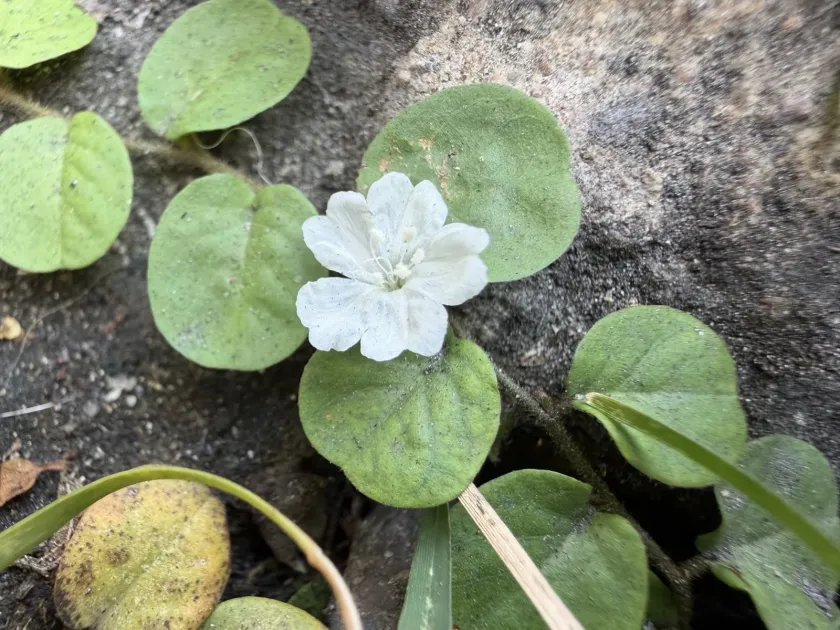
The leaves of the plant have a characteristic circular or kidney shape, resembling small coins. They are arranged oppositely along the stem and have a smooth, slightly glossy texture.
The flowers are solitary, small, and usually white or pale blue, possessing a funnel-shaped structure. They open primarily during sunny weather and are highly attractive.
The root system is aggressive and branched. The ability to propagate vegetatively via rooting stems allows the weed to quickly form dense ground-covering colonies.
The plant demonstrates high plasticity to light conditions, although it develops most actively in areas with sufficient moisture and fertile, well-draining soils.
Where it grows
Native to tropical and subtropical regions of the Americas, this weed has now spread widely across many warm-climate countries. It often appears as an invasive species in managed landscapes and greenhouses.
Evolvulus prefers moist meadows, stream banks, roadsides, and disturbed ground. It frequently occupies areas with high human activity, where it rapidly colonizes open space.
In agricultural systems, this weed actively infests row crops, particularly in irrigated agriculture. It is often found in perennial plantations such as orchards or berry fields.
In warm regions, the plant can quickly take over lawns and pastures, displacing valuable forage grasses due to its rapid horizontal growth pattern.
Seed dispersal occurs via irrigation water, as well as through contaminated agricultural equipment and soil, facilitating its quick expansion into new territories.
Harm it causes
The primary damage caused by Evolvulus is its ability to create a thick mat that completely suppresses the growth of crops during their early stages of development.
The weed actively competes for moisture and nutrients, creating a severe resource deficit for the main crop. This leads to significant yield losses even when fertilizer application is optimal.
The densely intertwined stems make mechanical field operations difficult, as they can clog the working components of cultivators and seeding machinery.
The plant serves as a reservoir for various viral and fungal diseases, which can then spread to neighboring agricultural crops.
Because of its creeping nature, the weed is difficult to eradicate through simple hand-weeding, as even small fragments of stems or roots can quickly regenerate new plants.
How to control
Controlling Evolvulus nummularius requires primarily agrotechnical methods aimed at depleting its root system through systematic cutting and cultivation.
Deep plowing with soil inversion helps reduce the population size, though it requires constant monitoring to address regrowth from surviving underground parts.
Using mulching materials can be an effective way to suppress weed growth in smaller areas, as the plant is highly sensitive to shading and lack of direct sunlight.
- Application of systemic herbicides based on glyphosate for spot treatments in infestation zones.
- Implementation of crop rotation using crops with high competitive ability.
- Regular cleaning of irrigation ditches to prevent the movement of vegetative fragments.
Chemical control is most effective during the active growth phase, when the plant is translocating nutrients to its root system, allowing for better herbicide uptake.
Taxonomy
- Latin name
- Evolvulus nummularius
- Family
- Вьюнковые
- EPPO code
- EVONU