
Kidney weed
Dichondra repens
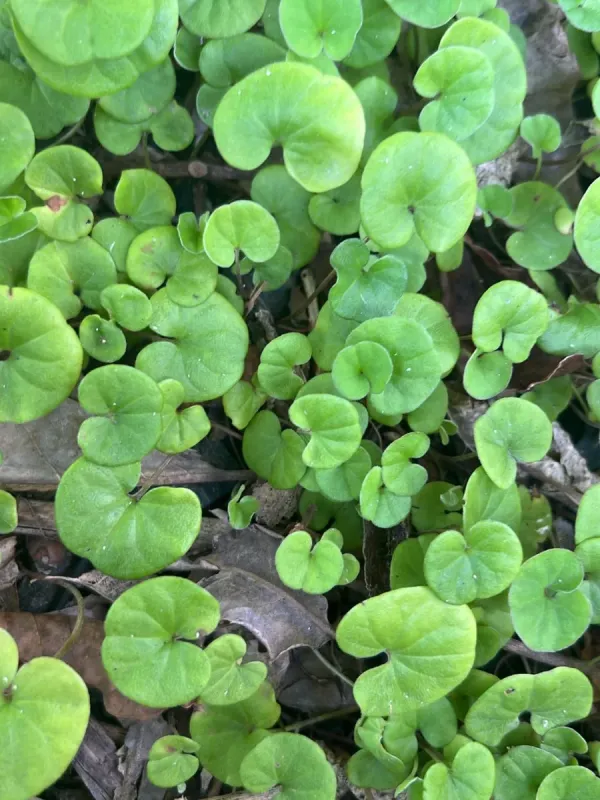
Description
How to tell it apart
Kidney weed (Dichondra repens) belongs to the Convolvulaceae family. It is a low-growing perennial herbaceous plant with creeping stems that actively root at the nodes upon contact with the soil.
The leaves of the kidney weed are kidney-shaped or rounded, arranged alternately on petioles. The surface of the leaf blade is covered with fine hairs, which gives it a characteristic silvery-green appearance.
The flowers are very small, solitary, axillary, usually yellowish-green or white, often hidden within the dense foliage and lacking significant ornamental value in the wild.
The root system is fibrous and shallow. Under favorable conditions, the plant forms a dense mat that displaces other vegetation, creating a continuous layer of turf.
Kidney weed propagates both by seeds and vegetatively through stem fragments, which easily establish if soil moisture remains consistently high during the growing season.
Where it grows
In its natural habitat, the plant is found in regions with warm climates, preferring shaded or semi-shaded areas with high humidity levels.
This weed is most commonly found in fields, gardens, park areas, and irrigated territories, where regular watering creates ideal conditions for its aggressive spread.
In agricultural crops, kidney weed becomes a serious problem in crops that require frequent irrigation, including vegetable plantings and young decorative plant nurseries.
The plant demonstrates high resistance to trampling, allowing it to quickly colonize paths, inter-row spaces, and areas along borders, becoming a dominant species in the ground cover.
Regarding soil requirements, kidney weed prefers loose, fertile ground, although it can adapt to various soil types provided there is adequate drainage and no waterlogging.
Harm it causes
The main damage caused by kidney weed lies in its ability to form thick mats that block sunlight and nutrients from reaching cultivated plants, thereby slowing their growth.
Due to its shallow root system, kidney weed actively absorbs moisture from the topsoil, competing with primary crops, especially during drought periods.
The weed serves as a reservoir for various pests and fungal pathogens, which can subsequently spread to valuable agricultural and horticultural crops.
In lawns and flower beds, the presence of kidney weed disrupts aesthetic uniformity, necessitating labor-intensive efforts to clean the area of unwanted vegetation.
Large-scale infestation of kidney weed complicates plot maintenance and requires significant financial investment for regular weeding or the application of specialized chemicals.
How to control
Agrotechnical control methods include manual weeding, which is effective only if the entire root system is removed, as any remaining stem fragment will sprout new growth.
An important technique is improving site drainage and adjusting watering schedules, as kidney weed is extremely sensitive to moisture stress and easily dies when the soil is allowed to dry out.
Mulching the soil with dark, light-blocking materials, such as black landscape fabric, suppresses weed development by depriving it of the light necessary for photosynthesis.
For chemical control, systemic non-selective herbicides based on glyphosate (for total clearing) or selective herbicides designed to target broadleaf weeds are commonly used.
- Regular soil aeration.
- Timely fertilization of crops to improve their competitive ability.
- Localized application of herbicides on the foliage during active growth phases.
- Use of antagonist cover crops to crowd out the weed.
Taxonomy
- Latin name
- Dichondra repens
- Family
- Вьюнковые
- EPPO code
- DIORE