
Smartweed dodder
Cuscuta polygonorum
Description
How to tell it apart
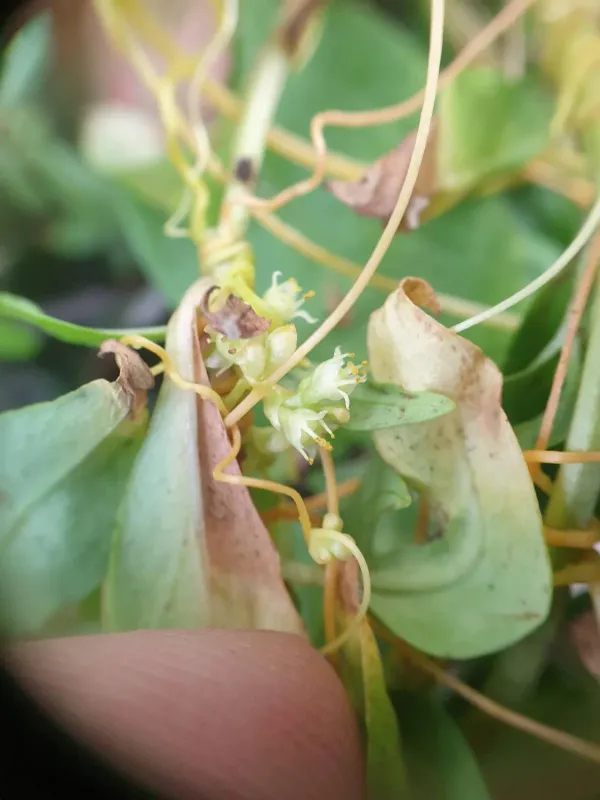
Smartweed dodder is an obligate parasitic plant that lacks roots and true leaves. The body consists of a thread-like, highly branched stem that ranges in color from yellow to reddish.
It utilizes specialized structures known as haustoria to anchor itself onto the host plant. These organs penetrate deep into the host's stems to extract water and essential nutrients for survival.
The flowers are very small and clustered in compact, head-like inflorescences. The specific structure of the perianth allows botanists to distinguish this species from other dodder types.
The seeds are minute and possess a rough surface, which facilitates their attachment to agricultural machinery, animal coats, and human clothing, leading to long-distance dispersal.
Classified within the Convolvulaceae family, this annual plant relies entirely on host plants for its energy needs, as it cannot conduct photosynthesis in its mature, leafless state.
Where it grows
This species primarily parasitizes members of the Polygonaceae family, particularly smartweeds (genus Polygonum). It is typically found in riparian zones, meadows, and humid environments near water.
In agricultural settings, Smartweed dodder can severely damage cereal and vegetable crops if they are grown near moisture-rich areas where the weed naturally thrives.
The plant favors well-lit areas with dense vegetation that provides structural support for the dodder stems to twine around. Without a suitable host, the life cycle is broken.
Contaminated seed lots are a major pathway for its spread. Inadequate cleaning of harvested crops allows dodder seeds to remain in the grain, ready to infest new fields during planting.
Smartweed dodder is remarkably resilient to environmental changes, allowing it to colonize new territories effectively whenever compatible host species are present in sufficient density.
Harm it causes
The harm caused by dodder is primarily due to the direct depletion of host resources. By diverting water and nutrients, the parasite stunts the growth and development of the infested crop.
Heavy infestations often lead to lodging and the death of host plants. The overall yield of the affected crop is significantly reduced, and the harvested quality is often drastically lowered.
Smartweed dodder acts as a vector for various plant viruses. The haustoria create open wounds that serve as entry points for bacterial and fungal pathogens to infect the host plant.
The presence of dodder in harvested grain increases moisture levels and adds undesirable debris, which can lead to rapid deterioration and spoilage during storage if not processed correctly.
Economic losses include both the direct reduction in output and the high costs associated with quarantine measures, field monitoring, and site-specific eradication efforts.
How to control
The primary method of control is strict phytosanitary compliance. Using certified, high-quality, and weed-free seeds is the most effective preventative measure against infestation.
Agronomic strategies include deep plowing, which buries seeds and prevents them from reaching the surface, and crop rotation with non-host species to disrupt the parasite's life cycle.
When an infestation is detected, infected plants should be cut along with the host plants and burned immediately to prevent the maturation and dispersal of new dodder seeds.
Chemical control can involve the use of contact herbicides or selective treatments in specific areas, applied before the dodder flowers and sets its own seed for the following season.
- Sanitize agricultural equipment after moving from infested areas.
- Manage weed populations along field borders and non-crop margins.
- Regular field inspections during the peak growth season.
Taxonomy
- Latin name
- Cuscuta polygonorum
- Family
- Вьюнковые
- EPPO code
- CVCPO