
Gronovius dodder
Cuscuta gronovii
Description
How to tell it apart
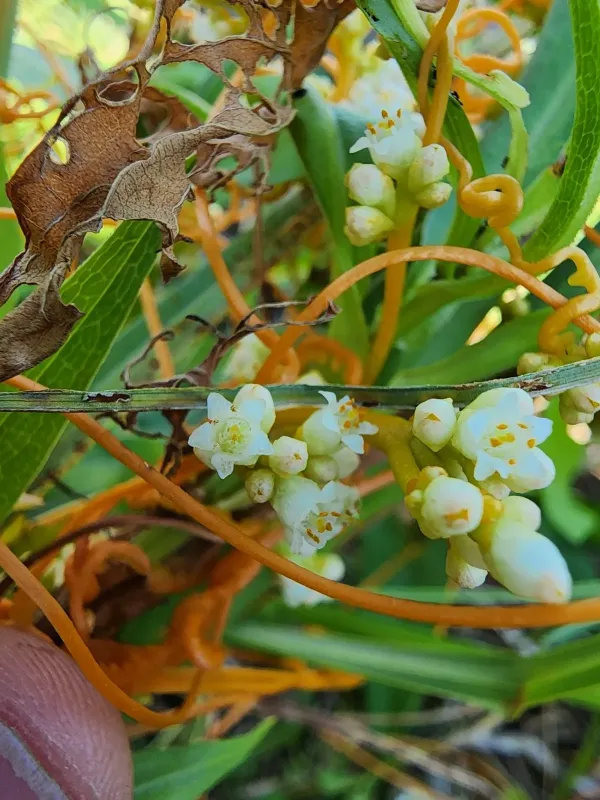
Gronovius dodder (Cuscuta gronovii) is a parasitic annual plant within the Convolvulaceae family. It lacks chlorophyll, appearing as a network of thin, orange to yellow, thread-like stems that entwine around host plants.
The plant possesses no true root system after the initial seedling stage. Instead, it develops haustoria—specialized organs that penetrate the host's vascular tissues to extract water and nutrients necessary for its survival and growth.
Small, white, bell-shaped flowers emerge in clusters during mid-summer. Following flowering, the plant produces numerous seeds that are highly resilient, remaining viable in the soil for up to ten years.
The stems are delicate and branching, allowing the parasite to spread rapidly across diverse host species. Once established, it forms dense mats of vegetation that can cover entire fields if left unmanaged.
As an obligate parasite, a dodder seedling must attach to a suitable host within days of germination, or it will perish, as it cannot sustain itself through photosynthesis.
Where it grows
Gronovius dodder is commonly found in moist habitats, such as riverbanks, wetlands, and damp meadows. However, it frequently infests agricultural settings, particularly in fields with lush, dense vegetation.
Crop hosts include a wide variety of species, such as alfalfa, clover, various vegetables, and ornamentals. It often enters clean fields through contaminated seed lots or equipment that has transported seeds from infested areas.
Natural infestations often occur in wild brush or high-density weed patches in riparian zones. These act as reservoirs, from which seeds are dispersed by flooding, wind, or animals moving through the area.
The plant thrives in conditions with high humidity and dense plant cover, which provides the necessary shade and moisture for the early development of its haustoria after attaching to a host.
Its wide range of potential hosts and ability to survive in diverse environmental conditions make it an adaptable and persistent weed in many agricultural regions.
Harm it causes
The primary damage caused by Gronovius dodder is the severe depletion of host nutrients. By siphoning sugars and minerals from crops, the parasite significantly weakens them, leading to stunted growth and yield loss.
This species is a known vector for various viral and phytoplasmal pathogens. As it connects multiple host plants, it effectively facilitates the spread of infectious diseases across entire crop fields.
Infested crops often exhibit poor vigor and increased susceptibility to environmental stressors, such as extreme heat or frost. The quality of produce is often degraded, rendering it unmarketable.
In perennial crops like clover and alfalfa, dodder can form large, impenetrable patches that destroy the economic value of the stand and prevent standard mechanical harvesting techniques.
Post-harvest losses are also significant; if dodder stems are harvested along with the crop, their high moisture content causes rot and heating, damaging the stored commodity.
How to control
The most effective management strategy is prevention. This includes the rigorous inspection of seed lots to ensure they are free from dodder contamination and cleaning equipment before entering new fields.
Cultural control methods involve deep plowing to bury seeds, making them unable to germinate effectively, and implementing crop rotations with non-host species to break the life cycle of the parasite.
If an infestation is detected, immediate action is required. Plants should be cut and destroyed (preferably by burning) within and around the infested perimeter to prevent the dissemination of seeds.
Chemical control options are generally limited due to the close physiological association between the parasite and the host. Herbicide application is usually directed at specific infested patches rather than the entire crop.
- Use certified weed-free seed for planting.
- Promptly remove and incinerate infected plant tissue.
- Implement field sanitation and equipment cleaning protocols.
- Rotate crops with grasses to reduce the parasite's host options.
Taxonomy
- Latin name
- Cuscuta gronovii
- Family
- Вьюнковые
- EPPO code
- CVCGR