
Cressa truxillensis
Cressa truxillensis
Description
How to tell it apart
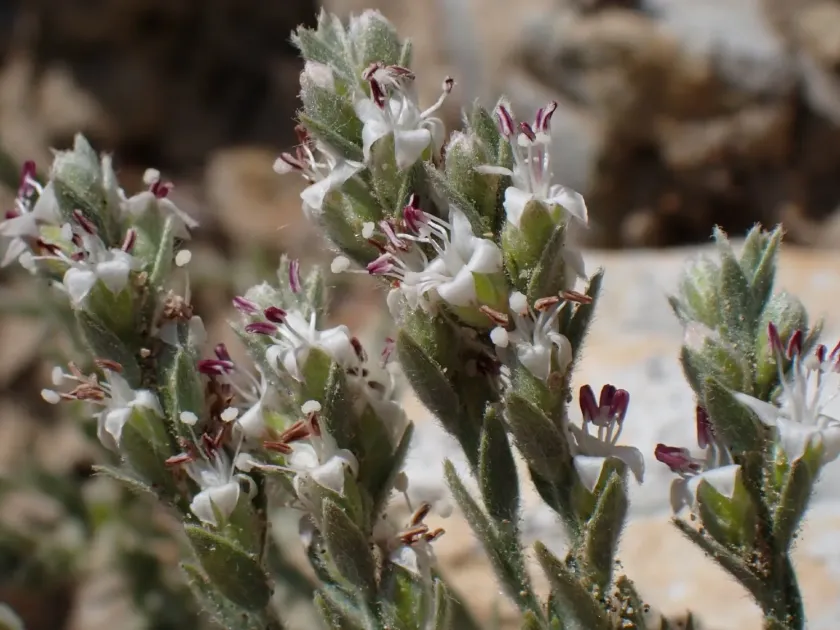
Cressa truxillensis is a perennial herbaceous plant belonging to the Convolvulaceae (morning glory) family. It typically forms small, heavily branched stems that stay close to the ground.
The leaves are small, alternate, and often sessile. A notable feature is their dense pubescence (hairs), which provides protection against high evaporation rates in arid environments.
Flowers are white or pale pink, solitary, or clustered in small groups in the leaf axils. The plant’s ability to bloom under stress makes it easy to identify during the late growing season.
The root system is remarkably deep and resilient. This allows the plant to access moisture reserves deep in the soil profile, ensuring its survival during prolonged droughts.
Its growth pattern allows it to form dense mats in favorable conditions, effectively outcompeting other species for limited space in disturbed soil environments.
Where it grows
This weed is native to and commonly found in arid and semi-arid regions. It thrives in saline soils, coastal areas, and abandoned agricultural lands where competition is low.
In modern agriculture, it is a significant nuisance in irrigated crops where secondary salinization of the soil creates an environment tailored to the plant’s physiological needs.
It frequently colonizes field margins, canal banks, and uncultivated patches, using these areas as focal points for invasion into main crop fields.
The plant is highly adaptable and can survive in both sandy and clay-heavy soils, provided there is enough space and access to the necessary mineral salts.
Increased human activity and the movement of soil during field preparation often facilitate the dispersal of seeds and root fragments to new, previously uninfested areas.
Harm it causes
Cressa truxillensis acts as a fierce competitor for nutrients and soil moisture. Its presence can significantly reduce the yield of primary crops by limiting their water intake.
The plant can physically crowd out crop seedlings in their early stages of growth, which often leads to poor crop establishment and the need for costly reseeding.
In fields destined for mechanical harvesting, the biomass of this weed can interfere with equipment, leading to higher fuel consumption and increased moisture levels in harvested grains.
It may also impact livestock production by reducing the quantity of high-quality forage in natural or managed pastures, as the plant is not preferred by most animals.
By competing for light and space, it creates micro-environments that may favor other weed species or soil-borne pathogens, leading to a broader management issue.
How to control
Mechanical management involves deep plowing to disturb the extensive root system. Multiple passes during the fallow period are essential to prevent the plant from recovering through vegetative growth.
Cultural practices, such as competitive crop planting, are effective in limiting its growth. Ensuring optimal soil drainage can also reduce the salt content, making the environment less hospitable.
Chemical control often requires the use of systemic herbicides applied during the active growth stage. Monitoring the timing of application is crucial for maximizing efficacy against the root system.
Field sanitation is vital. Preventing the weed from reaching the seed-bearing stage along field edges can significantly reduce the pressure on adjacent crops.
- Deep tillage for root system destruction.
- Use of pre-emergence and post-emergence herbicides.
- Crop rotation with tall, dense canopy species.
- Regular monitoring of field borders for new infestations.
Taxonomy
- Latin name
- Cressa truxillensis
- Family
- Вьюнковые
- EPPO code
- CSVTR