
Prostrate bindweed
Convolvulus prostratus
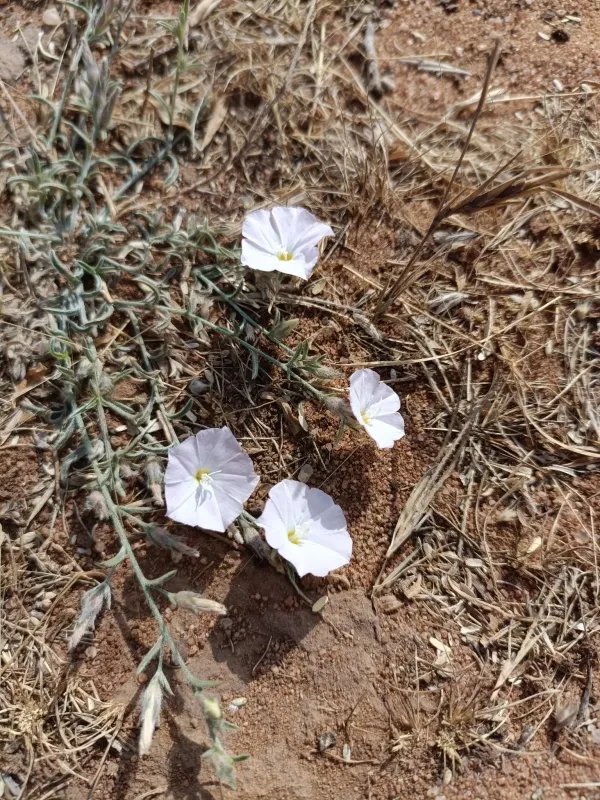
Description
How to tell it apart
Prostrate bindweed (Convolvulus prostratus) is a perennial herbaceous plant from the Convolvulaceae family, classified as a rhizomatous weed.
The plant exhibits prostrate growth, with stems spreading across the soil surface, often forming dense mats that suppress surrounding vegetation.
Leaves are small, lanceolate or linear, and frequently covered with fine hairs, an evolutionary trait that helps the plant thrive in arid environments.
The flowers are characteristically funnel-shaped, typically white or light pink, and bloom during the day, attracting various insects.
Its root system is deep and highly resilient, allowing the plant to survive severe drought and physical disturbance by mechanical field operations.
Where it grows
Prostrate bindweed prefers open, sunny, and dry sites, such as sandy or rocky soils, roadsides, and abandoned agricultural lands.
In agricultural settings, it commonly infests cereal and legume crops, particularly in regions with limited rainfall or poor soil conditions.
The weed often colonizes fallow fields and edges of arable land, acting as a source for re-infestation of nearby cultivated areas.
It is well-adapted to saline soils and environments low in nutrients, where it often outcompetes more sensitive plant species.
Its natural range covers the arid and semi-arid zones of Eurasia, where it is highly tolerant to extreme heat and prolonged dry spells.
Harm it causes
The primary damage caused by this weed is the depletion of soil moisture and nutrients, which significantly reduces crop development and yields.
By forming dense mats, prostrate bindweed shades young seedlings, preventing them from achieving optimal growth rates during the early vegetative stage.
The plant competes aggressively for sunlight, moisture, and minerals, often forcing crop plants to struggle for resources throughout the growing season.
During harvesting, the massive vegetative growth of the weed interferes with machinery, causing clogging, increased fuel consumption, and higher grain losses.
Additionally, it serves as a host plant for various insects and pathogens that can subsequently spread to and damage commercial agricultural crops.
How to control
Agronomic control involves deep plowing with soil inversion, which disrupts the root system and reduces the weed's energy reserves.
Systematic cultivation of fallow fields throughout the season is essential to deplete the rootstock and prevent seed bank replenishment.
Post-harvest application of systemic herbicides is a highly effective way to manage the weed by translocating the chemical into the deep roots.
In growing crops, selective herbicides are employed to manage the weed population without harming the main cultivated plants.
- Ensure seed purity by cleaning agricultural inputs.
- Implement diverse crop rotation strategies to minimize weed pressure.
- Use competitive cover crops to suppress the growth of bindweed patches.
Taxonomy
- Latin name
- Convolvulus prostratus
- Family
- Вьюнковые
- EPPO code
- CONPR