
Spreading bindweed
Convolvulus equitans
Description
How to tell it apart
Spreading bindweed (Convolvulus equitans) belongs to the Convolvulaceae family. It is a perennial herbaceous plant known for its persistent root system and climbing growth habit.
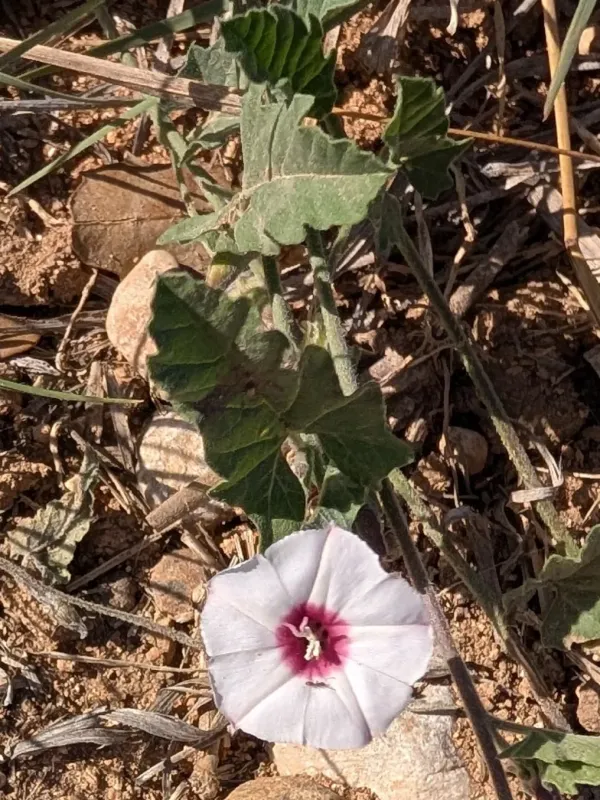
The plant is distinguished by its leaves, which feature prominent sagittate (arrowhead-like or saddle-like) bases. The stems are twining and flexible, allowing the plant to climb effectively on nearby vegetation.
Flowers are characteristically funnel-shaped, typically white to pale pink, and open during the day. The plant produces small, resilient seeds that can remain dormant in the soil for several years.
Its deep taproot system allows it to survive in harsh, arid environments. Even small segments of the root can regenerate into full plants, making mechanical eradication particularly difficult.
The growth cycle of this species is optimized for rapid colonization of disturbed areas, making it a competitive weed in agricultural and natural environments alike.
Where it grows
Spreading bindweed thrives in warm and arid climates, commonly occupying roadsides, neglected pastures, and the edges of cultivated fields.
It prefers well-lit environments and is capable of growing in various soil types, particularly favoring loose, well-drained loams where deep root penetration is possible.
In cropping systems, it is a significant nuisance in grain fields and row crops, particularly where conservation tillage practices are employed.
The weed adapts well to human-disturbed landscapes, rapidly establishing itself in agricultural systems that lack rigorous weed management strategies.
Its distribution is wide across regions with intensive farming, where it exploits available water and nutrients to outcompete standard crops.
Harm it causes
The primary damage caused by spreading bindweed is the severe competition for water and soil nutrients, which can drastically reduce yield in dryland farming.
By twining around crop stems, the weed causes lodging, which physically weakens the plants and makes mechanical harvesting extremely difficult and slow.
The dense foliage of the bindweed shades out the crop, reducing the light interception necessary for optimal photosynthesis and grain filling.
Bindweed serves as a host for various pathogens and pests, potentially increasing the disease pressure within the agricultural field.
The presence of this weed significantly increases operational costs due to the need for extra herbicide applications and the cleaning of contaminated harvest yields.
How to control
Successful management of spreading bindweed requires an integrated approach that utilizes both cultural and chemical control measures to exhaust the root system.
Mechanical control involves repeated deep tillage or cultivation to disrupt and exhaust the energy reserves stored in the extensive root network.
Chemical control usually involves the use of systemic herbicides applied during the plant's active growth phase to ensure translocation to the roots.
Crop rotation using competitive, fast-growing species can help shade the bindweed, reducing its ability to establish or spread across the field.
- Implementing deep plowing during fallow seasons.
- Using systemic herbicides during the flowering or pre-flowering stage.
- Maintaining a rigorous schedule of mechanical cultivation.
Taxonomy
- Latin name
- Convolvulus equitans
- Family
- Вьюнковые
- EPPO code
- CONEQ