
Canary bindweed
Convolvulus canariensis
Description
How to tell it apart
Canary bindweed (Convolvulus canariensis) is a member of the Convolvulaceae family. It is a perennial evergreen plant featuring vigorous vining stems that can quickly climb and overtake other structures and plants.
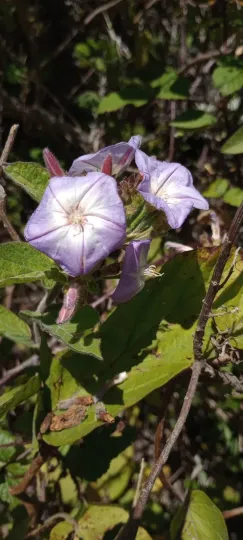
A distinctive feature of this species is the noticeable pubescence on its stems and leaves, giving the plant a soft, greyish-green appearance. The leaves are typically heart-shaped or triangular and arranged alternately along the stem.
The flowers are large, funnel-shaped, and usually display delicate shades of pink or white, which makes them look attractive despite the plant being classified as a weed in agricultural settings.
The root system of Canary bindweed is robust and penetrates deeply into the soil, providing the plant with high resilience and the capacity to regenerate quickly after physical disturbance.
Reproduction occurs through both seeds and vegetative propagation, a combination that makes controlling the spread of this species particularly challenging on farmland.
Where it grows
The native habitat of this species is the Canary Islands, where it is found in diverse plant communities, including forest edges, rocky slopes, and open disturbed areas.
It prefers well-drained, sunny locations with moderate moisture levels and often colonizes roadsides, abandoned fields, and gardens where it behaves as an aggressive invasive species.
In agricultural fields, Canary bindweed poses a threat because it can quickly smother crops, depriving them of vital sunlight and necessary soil nutrients.
While its range is limited by climate, the species demonstrates high adaptability to various soil types, allowing it to establish itself in different agricultural landscapes.
Intensive spread of this weed leads to soil compaction and significantly complicates routine agricultural operations such as inter-row cultivation and harvesting.
Harm it causes
The primary damage caused by Canary bindweed is its ability to create dense, tangled mats of stems that stifle crop development, directly reducing overall plant productivity.
Bindweed actively competes with crops for water and mineral elements, which is especially critical during dry seasons, often leading to yield losses of 30% or more.
The dense foliage creates significant shading, which inhibits photosynthesis in crop plants and fosters a microclimate conducive to the development of various fungal pathogens.
Additionally, Canary bindweed can act as an alternative host for several pests and viral infections that eventually spread to high-value agricultural crops.
The presence of this weed in fields hampers the efficiency of heavy machinery, causing clogging in harvesting equipment and increasing maintenance costs for farmers.
How to control
Agrotechnical control measures include deep autumn plowing, which serves to cut the robust root system and expose it to the surface, leading to desiccation.
Systematic inter-row cultivation is essential for depleting the nutrient reserves stored in the roots and preventing the emergence of new shoots throughout the growing season.
Chemical control strategies rely on the use of systemic herbicides, which are absorbed through the leaves and translocated to the deep-seated roots of the weed.
- Application of glyphosate-based herbicides during the plant's active growth phase.
- Use of selective herbicides to protect target crops during their development.
- Implementation of crop rotation patterns that favor dense canopies to suppress weed growth.
An integrated approach that combines precise mechanical treatment with timely chemical applications is the most effective method for managing and removing Canary bindweed from agricultural land.
Taxonomy
- Latin name
- Convolvulus canariensis
- Family
- Вьюнковые
- EPPO code
- CONCA