
Mallow-leaved bindweed
Convolvulus althaeoides
Description
How to tell it apart
Mallow-leaved bindweed (Convolvulus althaeoides) is a perennial herbaceous plant belonging to the Convolvulaceae family. It is recognized for its aggressive growth and resilience in diverse environments.
The plant features trailing or climbing stems that can grow quite long, allowing it to twine around surrounding vegetation and structures, making it a significant nuisance.
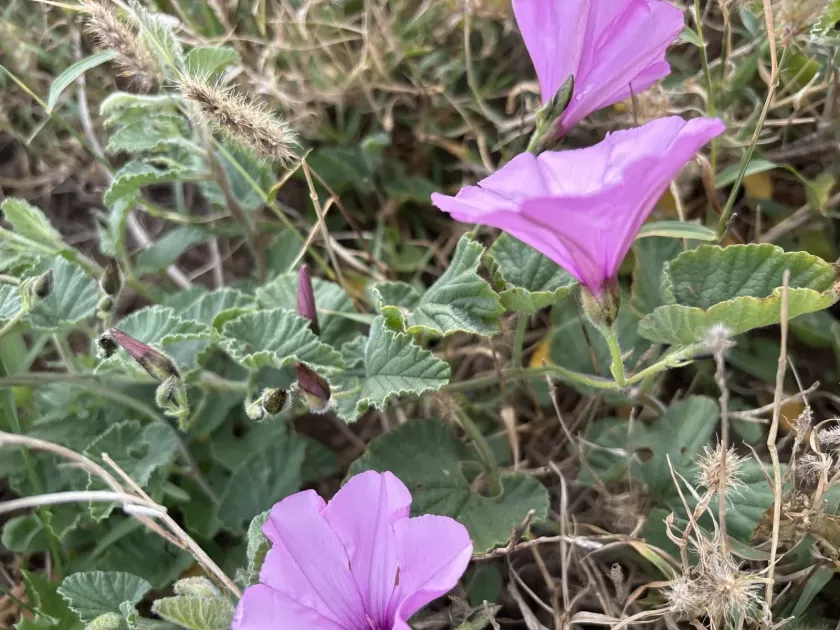
Its leaves are typically heart-shaped or sagittate with distinctive lobes, often covered in fine hairs that give them a silvery-grey appearance compared to other bindweed species.
The flowers are large, funnel-shaped, and usually bloom in shades of pink or purple. They appear individually or in small clusters from the leaf axils during the growing season.
A deep, extensive root system is the plant's hallmark, enabling it to propagate vegetatively even if only small segments of the root are left in the soil after tilling.
Where it grows
This weed thrives in sunny, open areas including fields, pastures, roadsides, and uncultivated lands where competition from taller plants is limited.
In agricultural settings, it frequently infests cereal crops, orchards, and perennial forage crops, often spreading rapidly along the margins of managed fields.
It prefers well-drained, sandy or rocky soils and is particularly well-adapted to the Mediterranean climate, where it remains active for a large part of the year.
The species is highly tolerant of drought conditions, as its deep root system can access moisture reserves unavailable to most common annual crop species.
It readily colonizes disturbed ground, utilizing both wind-dispersed seeds and vegetative regeneration to occupy new territories within a short timeframe.
Harm it causes
The primary damage caused by this weed is the direct competition with crops for water, sunlight, and soil nutrients, leading to significant yield losses.
Twining stems often cause crop lodging, which interferes with machine harvesting and reduces the overall quality of the harvested produce.
By shading the foliage of crop plants, it drastically reduces the efficiency of photosynthesis, stunting plant development and reducing overall biomass.
Mallow-leaved bindweed acts as a host for various agricultural pathogens and pests, potentially increasing the disease pressure on surrounding crops.
The persistent nature of its root system makes it difficult to eradicate, often requiring repeat interventions that increase total production costs for farmers.
How to control
Cultural control involves deep mechanical tillage to disrupt the root structure and encourage drying, especially during the dry season to maximize mortality.
Integrating competitive crops into the rotation can help shade out the bindweed, as it does not perform well under intense competition for light.
Chemical control using systemic herbicides applied at the appropriate growth stage is the most reliable method for long-term suppression of the root system.
Post-harvest herbicide applications are highly effective because the plant is translocating nutrients to its roots, allowing for better chemical uptake.
- Regular monitoring and spot-treatment of infestations.
- Use of clean, certified seeds to prevent introduction.
- Early detection before the plant establishes its perennial root system.
Taxonomy
- Latin name
- Convolvulus althaeoides
- Family
- Вьюнковые
- EPPO code
- CONAL