
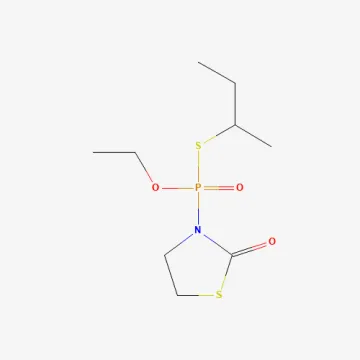
Fosthiazate
Description
Mode of action
Fosthiazate is an organophosphorus compound that acts as a systemic nematicide and insecticide with potent contact and stomach activity.
Its mode of action involves the irreversible inhibition of the enzyme acetylcholinesterase, which is crucial for nervous system function.
By interfering with nerve impulse transmission, the chemical induces paralysis in pests, preventing them from feeding or moving, leading to mortality.
The substance is absorbed by the plant roots and translocated systematically throughout the plant, establishing a protective internal barrier.
This systemic movement ensures that even roots emerging after the initial application remain protected from nematode penetration for a period.
What it targets
The primary use of Fosthiazate is the management of soil-borne plant-parasitic nematodes that attack roots and limit crop yield.
It is highly effective against root-knot, stem, and cyst nematodes, which are major threats in both open-field and greenhouse vegetable production.
In addition to its nematicidal effects, the compound provides control over various soil-dwelling insects, such as wireworms.
Crops commonly protected include potatoes, tomatoes, cucumbers, peppers, and various ornamental plants.
- Root-knot nematodes (Meloidogyne spp.)
- Stem nematodes (Ditylenchus spp.)
- Potato cyst nematodes
- Wireworms (Agriotes spp.)
Rates and timing
The application rate for Fosthiazate is determined by the specific pest infestation level and the soil type where the crop is grown.
Treatment usually involves uniform soil incorporation into the top 10–15 cm layer before planting or sowing to ensure root zone protection.
Precision in application equipment is necessary to ensure the granules are distributed evenly and not concentrated in one spot.
Timing is critical: the product should be applied as close to planting as the label regulations permit to maximize the protection period.
Farmers must consult local guidelines regarding the maximum number of applications allowed per season to prevent soil residue accumulation.
Restrictions
Fosthiazate is classified as highly toxic, requiring strict adherence to occupational safety standards during handling and application.
Operators must wear full personal protective equipment (PPE), including chemical-resistant gloves, boots, and respiratory protection.
Environmental protection is paramount; the substance must not be applied near water bodies, as it is dangerous to aquatic life.
Pre-harvest intervals (PHI) must be meticulously observed to ensure that chemical residues in the final produce remain within legal limits.
Storage facilities must be secure, well-ventilated, and clearly marked to prevent accidental exposure to humans or domestic animals.
Status in the European Union
Approved in the EU
- CAS number
- 98886-44-3
- Category (EU)
- NE - Nematicide
- Approved from
- 01.01.2004
- Approval until
- 31.01.2027
- ADI
- 0.004 mg/kg bw/day
- ARfD
- 0.005 mg/kg bw
- AOEL
- 0.005 mg/kg bw/day
EU status is for reference only and does not replace national registration in your country.