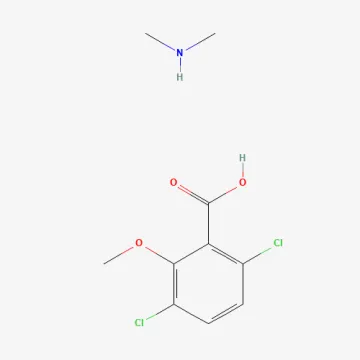
Active ingredient
Especially harmful
Dicamba dimethylamine salt
Description
Mode of action
Dicamba dimethylamine salt belongs to the benzoic acid chemical class. It is a selective systemic herbicide that acts as a synthetic auxin, mimicking the activity of natural plant growth hormones.
Once absorbed by the leaves and roots, the active ingredient translocates rapidly through the phloem and xylem to the plant's growing points. This causes uncontrolled cell division, leading to tissue deformation and rapid weed necrosis.
Unlike many other herbicides, dicamba is highly effective against perennial weeds with deep root systems, as it transports to the underground parts and destroys them completely.
The substance disrupts basic physiological processes such as respiration and protein synthesis, which ensures the efficacy of the treatment even in varied environmental conditions.
The dimethylamine salt formulation is characterized by high solubility and rapid uptake, which makes it a cornerstone in modern weed management systems for cereal crops and corn.
What it targets
This substance is widely used to control a broad range of broadleaf weeds, specifically those that are resistant to other common herbicide classes.
Key target weeds include: field bindweed, Canada thistle, sow thistle, pigweed, ragweed, lamb's quarters, and various species of knotweed and smartweed.
- Field bindweed
- Canada thistle
- Common lamb's quarters
- Common ragweed
- Smartweed species
Rates and timing
Application rates are determined by the crop growth stage and the weed pressure in the field. Ideally, the herbicide should be applied when weeds are actively growing to maximize systemic uptake.
For cereal crops, application is usually performed from the tillering stage up to the jointing stage. In corn, it is typically applied between the 3 and 5-leaf stages of the crop.
Tank mixing with other herbicides, such as sulfonylureas or phenoxy herbicides, is a common practice to broaden the spectrum of controlled weeds and improve performance against mature plants.
Environmental conditions, specifically temperature and humidity, play a vital role. Optimal efficacy is observed when temperatures are between 10 and 25 degrees Celsius.
It is essential to adjust the water volume per hectare to ensure complete coverage of the weed canopy while avoiding excessive runoff.
Restrictions
The most significant limitation is the risk of drift to sensitive crops, as dicamba is highly active and can cause severe damage to non-target plants even at very low concentrations.
Avoid applying the herbicide during windy weather or temperature inversions, which can carry the vapor or droplets far from the treated area, leading to legal and agronomic complications.
Do not apply the product if the crop is under stress from adverse weather conditions, pests, or nutrient deficiencies, as this may reduce crop safety and potential yield.
Consider residual soil activity when planning subsequent crop rotation, although dicamba generally degrades in the soil under favorable moisture and microbial activity conditions.
Always adhere to local safety regulations, use proper personal protective equipment, and ensure that all spraying equipment is thoroughly cleaned after use to prevent cross-contamination.
Content graph
Connections · Dicamba dimethylamine salt
Most often together:
Marketplace
Products · 12