

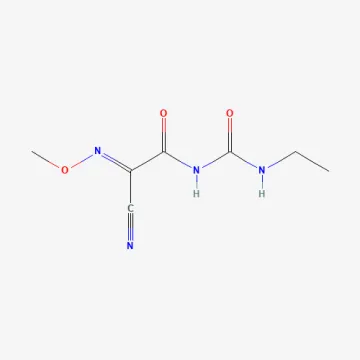
Description
Mode of action
Cymoxanil belongs to the cyanoacetamide oxime chemical class. It is a fungicide with pronounced curative, protective, and anti-sporulant action, designed to combat pathogens from the oomycete class.
The mechanism of action of the substance consists in suppressing the biosynthesis of nucleic acids, proteins, and lipids in fungal cells. This leads to a rapid cessation of mycelial growth and inhibition of the sporulation process.
The substance has the ability to quickly penetrate plant tissues, which provides high resistance to washing off by rainfall. It affects the fungus at all stages of development, including the incubation period.
Cymoxanil is often used as part of complex products, enhancing the action of contact components. Its integration into protection systems allows for effective control even of resistant pathogen strains.
The preparation is rapidly redistributed within the leaf, providing protection for untreated parts of the plant due to local systemic movement. This quality is critical during the intensive growth of green mass.
What it targets
The main purpose of cymoxanil is to control late blight, downy mildew (peronosporosis), and blight in grapes. It is effective against most representatives of the peronosporaceae family.
- Potatoes and tomatoes: against late blight and alternaria.
- Grapes: against downy mildew.
- Onions: against downy mildew.
- Cucumbers: against downy mildew.
Thanks to its curative effect, the substance can stop the development of the disease even when the first visual symptoms of damage appear on leaf blades.
The use of the preparation contributes to preserving the marketability of products and prevents crop losses during storage if infection occurred under field conditions.
The substance shows high efficacy during preventive treatments, preventing mass infection of crops when weather conditions become favorable for the fungus.
Rates and timing
Application rates vary depending on the specific formulation of the product; most manufacturers recommend using from 0.4 to 0.8 kg/ha of the active ingredient.
The timing of treatments is tied to the phenophases of crops and the forecast of epiphytotics. It is optimal to start spraying before the appearance of the first disease symptoms or during a critical risk of infection.
The interval between treatments during the active vegetation period ranges from 7 to 12 days. In case of a high infection background or weather favorable for the pathogen, the interval is reduced.
To prepare the working solution, clean water should be used. It is recommended to carefully adjust the spraying equipment for uniform coverage of all vegetative organs of the plant.
The frequency of treatments per season is usually limited to 2–3 times to avoid accumulation of the active ingredient and to prevent the emergence of resistant fungal populations.
Restrictions
Cymoxanil is moderately toxic to warm-blooded animals, so standard safety measures must be followed when working with it: use PPE for skin, eyes, and respiratory tracts.
It is forbidden to carry out treatment in conditions of strong wind or high air temperature, as this reduces the effectiveness of the product and increases the risk of drift to neighboring crops.
Storage of the preparation should be carried out in a cool, dry place inaccessible to children, separately from food products and feed for farm animals.
It is not recommended to mix cymoxanil with products that have a strong alkaline reaction, as this may lead to degradation of the active ingredient and loss of fungicidal properties.
After finishing the work, it is necessary to thoroughly wash the sprayer to exclude the ingress of fungicide residues onto other crops during subsequent plant protection operations.
Regulatory
Status in the European Union
Approved in the EU
- CAS number
- 57966-95-7
- Approved from
- 01.09.2009
- Approval until
- 15.08.2026
- ADI
- 0.013 mg/kg bw/day
- ARfD
- 0.08 mg/kg bw
- AOEL
- 0.01 mg/kg bw/day
Hazard classification (CLP)
Acute Tox. 4 - H302Aquatic Acute 1 - H400Aquatic Chronic 1 - H410Repr. 2 - H361fdSTOT RE 2 - H373Skin Sens. 1 - H317
EU legislation
EU status is for reference only and does not replace national registration in your country.
Content graph
Connections · Cymoxanil
Most often together:
Marketplace
Products · 40


Copper Shield
Дефенда, Україна, Сімейний Сад, Україна
Fungicides
0
0
·
59
41 offer
11.6 €per 1 l
Buy


FITOFORTIN
«Нанджин Ессенс Файн-Кемікал Ко. Лтд» (Китай)
Fungicides
0
0
·
50
4 offers
57.42 €per 1 l
Buy


Curzat R 44
«Дюпон Інтернешнл Оперейшнз Сарл», Швейцарія
Fungicides
0
0
·
46
1 offer
14.56 €per pack
Buy

Cymoxil ZP
Jiangsu Sevencontinent Green Chemical Co. Ltd, Jiangsu, КНР
Fungicides
0
0
·
46
9 offers
11.83 €per 1 l
Buy


Desfilar
Жеджианг Хебен Пестисайд енд Кемікалс Ко., Лтд., Китай
Fungicides
0
0
·
33
7 offers
1.71 €per 1 l
Buy

ZAHCIST, ZP (Metalaxyl, 100g/kg + Cymoxanil, 250g/kg)
ТОВ «Фабрика агрохімікатів», Черкаси, Україна
Fungicides
0
0
·
30
5 offers
17.94 €per 1 l
Buy


