
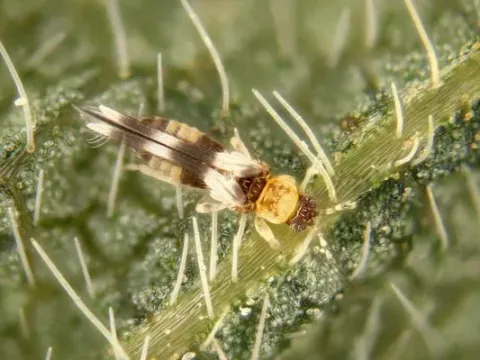
Soybean thrips
Sericothrips variabilis
Soybean thrips (Sericothrips variabilis) are tiny insects belonging to the order Thysanoptera and the family Thripidae. Adults measure approximately 1–1.5 mm in length and possess slender, yellowish-brown bodies with dark bands across the abdomen.
What the section contains
Soybean thrips
A distinctive feature of this species is its narrow, fringed wings, which lie flat along the back when the insect is at rest. The larvae resemble adults but are smaller, wingless, and typically exhibit a vibrant yellow or orange coloration.
These insects are equipped with piercing-sucking mouthparts, which they use to extract cell sap from plant tissues. The life cycle consists of the egg, two larval stages, prepupa, pupa, and finally the adult stage.
Reproduction can occur both sexually and parthenogenetically. Under favorable temperature conditions, a single generation can complete its development in as little as 15–20 days, allowing for rapid population growth.
Adults overwinter in plant debris, under tree bark, or in the upper layers of soil, emerging when warm spring weather triggers the onset of the growing season.
Soybean thrips primarily target soybeans, but they can also feed on various other legumes. Damage is caused by both adults and larvae, which congregate on the undersides of leaves, stems, and reproductive plant parts.
Feeding activities lead to the destruction of epidermal cells, which disrupts normal photosynthesis and transpiration. This significant stress stunts plant growth and reduces the overall yield potential of the soybean field.
Beyond mechanical damage, the soybean thrips acts as a critical vector for viral diseases, including the Tobacco Streak Virus and the Soybean Vein Necrosis Virus. This vector capacity makes them a serious threat to crop health.
The extent of the damage is highly dependent on the population density during the flowering and pod-filling stages. High infestations often result in the shedding of flowers and aborted pods, leading to yield losses.
Economic thresholds are used by agronomists to determine when chemical intervention is necessary, balancing the cost of treatment against the expected reduction in total harvest yield.
Infestation typically begins during the early vegetative stages, as adults migrate from weeds or alternative hosts to young soybean plants. Peak population densities are often observed during the mid-to-late growth stages.
Hot and dry weather patterns promote rapid reproduction, as these conditions accelerate the life cycle of each successive generation. Conversely, high humidity may slightly inhibit the population growth rate.
Multiple generations occur throughout the growing season, necessitating continuous monitoring from the seedling stage until the end of the pod-filling phase to detect outbreaks early.
As autumn approaches and temperatures drop, thrips seek out protected overwintering sites. Fields with heavy weed pressure along the borders provide excellent shelter for these pests during the winter months.
Effective timing of field scouting allows farmers to catch initial infestations, preventing the rapid spread of the population across the entire field and reducing reliance on synthetic insecticides.
The primary visual indicator of thrips damage is the appearance of silvery or whitish patches on the leaves. These patches are caused by the destruction of cells in the feeding areas, later turning brown.
Affected leaves may become deformed, curled, or chlorotic, showing significant signs of stunted development compared to healthy surrounding plants. This impacts the plant's ability to produce energy through photosynthesis.
Small, black spots of excrement left on the undersides of leaves are a definitive diagnostic sign of thrips activity. Detecting these deposits is a common way for scouts to confirm the pest's presence.
Flower loss is a significant indicator of damage; infested flowers often dry out and drop prematurely. Any pods that successfully develop may show characteristic speckling or scarring on their surfaces.
Professionals often use the "tap test," where plant terminals are shaken over a white sheet of paper. This method dislodges the tiny insects, making them easy to count and identify for threshold calculations.
Integrated Pest Management (IPM) is the most effective approach, combining cultural practices, biological control, and judicious use of insecticides to manage soybean thrips populations.
Cultural methods include crop rotation, effective weed management in and around fields, and deep plowing to destroy overwintering sites. These practices disrupt the pest's life cycle before it begins.
Chemical control should be applied based on economic thresholds to avoid unnecessary sprays. Rotating insecticide modes of action is essential to prevent the development of resistant thrips populations.
Biological control involves conserving natural enemies, such as pirate bugs and lacewings, which naturally prey on thrips larvae and adults, providing a sustainable layer of protection.
- Utilizing insecticide-treated seed coatings for early protection.
- Consistent scouting using sticky traps to monitor population spikes.
- Ensuring balanced soil fertility to improve soybean crop resilience.
- Maintaining spatial isolation from older soybean fields to prevent migration.