
Six-spotted thrips
Scolothrips sexmaculatus
Description
How to identify
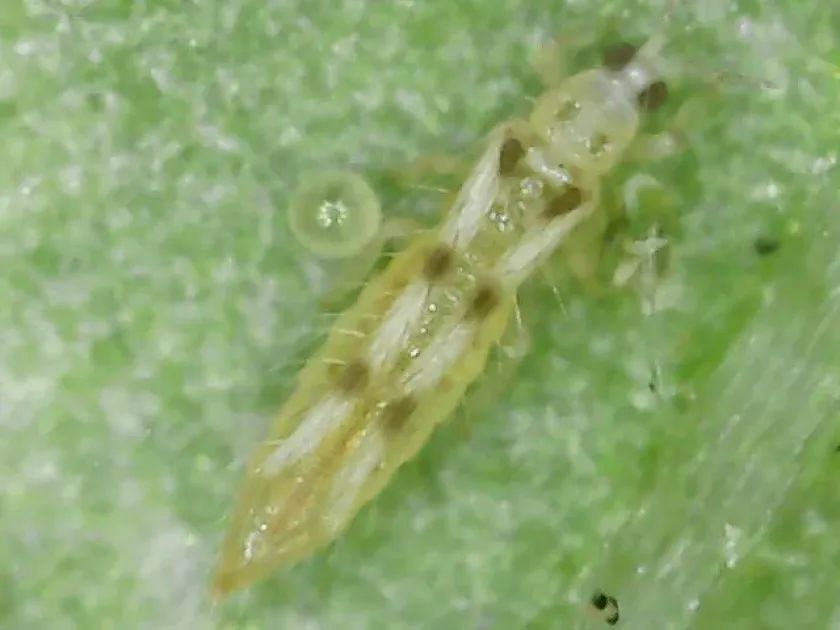
The six-spotted thrips (Scolothrips sexmaculatus) belongs to the Thripidae family. It is easily identified by the three pairs of dark spots on its forewings, which give the insect its distinct appearance and common name.
The adults are small, typically ranging from 1 to 1.5 mm in length, with a slender, yellowish-brown body. Like other thrips, they possess fringed wings, though their behavior differs significantly due to their predatory nature.
The life cycle of this species comprises egg, larva, propupa, pupa, and adult stages. Development is heavily dependent on ambient temperature and the availability of prey, specifically spider mites.
Adult females usually overwinter in sheltered locations such as leaf litter, bark crevices, or the upper layers of soil. They emerge in the spring once temperatures become favorable for hunting.
These insects are highly mobile and can quickly locate infestations of their prey, making them an effective component of natural pest control in various agricultural environments.
What it damages
The six-spotted thrips does not cause damage to plants; rather, it is a specialized predator of spider mites (Tetranychidae). It feeds on all stages of mites, including their eggs and larvae.
It is commonly found on a wide range of crops including apples, grapes, citrus fruits, and greenhouse cucumbers, where it serves as a natural enemy to mite outbreaks.
By consuming large numbers of spider mites, these thrips provide essential ecosystem services, reducing the need for chemical intervention in integrated pest management programs.
The presence of this species on a crop should be viewed as a positive indicator of natural biological control, suggesting that the ecosystem has a mechanism in place to manage mite populations.
Unlike herbivorous thrips that cause silvering or necrotic spots on leaves, the six-spotted thrips leaves no such damage, making it a highly desirable inhabitant for any farmer practicing sustainable agriculture.
Control measures
There is no need to control the six-spotted thrips as it is a beneficial predator. The primary goal for farmers and agronomists should be to conserve and encourage its population.
Avoid the use of broad-spectrum insecticides that are toxic to both pests and beneficial insects. Instead, implement selective pesticide programs that specifically target harmful organisms while sparing natural predators.
Maintaining floral strips or hedgerows near crop fields can provide refuge and alternative food sources for these predators when mite populations are low.
Regular field scouting and the use of monitoring tools like yellow sticky traps can help determine the presence of these thrips, allowing for informed decision-making regarding pest management.
Adopting an integrated pest management (IPM) approach ensures that predatory insects like the six-spotted thrips can perform their role, leading to more resilient and healthy crop production systems.
Taxonomy
- Latin name
- Scolothrips sexmaculatus
- Order
- Thrips
- Family
- Thripidae
- EPPO code
- SCLTSE
Discussion
No discussions yet — be the first.