
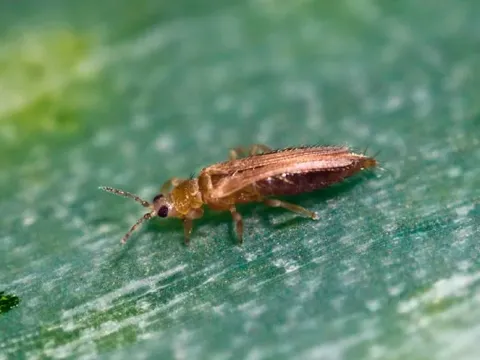
Onion thrips
Thrips tabaci
The onion thrips (Thrips tabaci) is a small insect in the order Thysanoptera. Adults are very slender, measuring about 1–1.2 mm in length, and vary in color from pale yellow to dark brown.
What the section contains
Onion thrips
These insects possess two pairs of wings with characteristic fringes. Despite their small size, they are highly mobile and can be easily dispersed by wind currents, facilitating the infestation of large agricultural areas.
The life cycle involves egg, two larval instars, prepupa, pupa, and adult stages. The transformation from egg to adult is rapid, allowing the population to increase exponentially during warm weather conditions.
Onion thrips thrive in hot and dry climates. During winter, they survive in the soil or in sheltered areas, such as greenhouse structures, plant debris, or weed hosts, emerging as soon as temperatures rise.
Females reproduce sexually or through parthenogenesis (asexual reproduction), which contributes to their high survival rate and the rapid colonization of various host plants throughout the growing season.
This pest is highly polyphagous, attacking a wide range of crops including onions, leeks, cabbage, cucumbers, tomatoes, and various ornamental plants. It feeds by piercing plant tissue and sucking out cell sap.
The feeding activity destroys the epidermis cells, leading to a characteristic silvery or whitish appearance on the leaves. This damage significantly reduces the photosynthetic efficiency of the plant.
As the feeding progresses, leaves may become distorted, curled, or stunted. In onions, the tips of the leaves often turn brown and die, which can lead to severe crop yield reduction and poor bulb quality.
Onion thrips are major vectors of plant viruses, most notably the Tomato Spotted Wilt Virus (TSWV). The transmission of these viruses often causes more economic damage than the physical feeding itself.
When high populations are present, the quality of the harvested produce is severely compromised, rendering it unsuitable for the market, especially in the case of leafy vegetables and decorative flowers.
One of the most obvious signs is the appearance of silvery streaking or patches on the foliage. Careful inspection of these spots often reveals tiny black specks, which are fecal deposits left behind by the thrips.
In infested greenhouses or fields, check the centers of new growth and inside flower buds. These areas provide protection for the insects and are usually the first places where larvae are found.
Another sign is the premature yellowing and drooping of foliage. If the plant shows symptoms of drought stress despite adequate soil moisture, it may be a strong indicator of a heavy thrips infestation.
Flower deformation and discolored stripes on petals are common in floriculture. In addition, many buds may fail to open fully due to the continuous feeding damage on the developing tissues.
Monitoring using blue sticky cards is an effective diagnostic tool. If you see numerous adults stuck to the cards, it is a clear sign that an immediate intervention strategy is required.
Cultural control practices are essential. These include crop rotation, removing crop residues after harvest, and controlling weed hosts around the perimeter of the field to eliminate breeding grounds.
Biological control agents, such as predatory mites (e.g., Amblyseius spp.) and pirate bugs (Orius spp.), can significantly reduce thrips populations. These are especially effective in controlled environment agriculture.
Chemical control should be implemented judiciously by alternating insecticide classes to prevent the development of resistance. Systemic insecticides are often preferred due to the pest's habit of hiding in plant crevices.
Irrigation management is also helpful, as thrips generally prefer drier conditions. Increasing field humidity can sometimes create unfavorable conditions for their rapid reproduction.
- Monitor fields regularly with blue sticky traps.
- Ensure adequate sanitation in and around greenhouses.
- Use certified, pest-free seedlings for planting.
- Apply insecticides early before the population peaks.