
Variegated grasshopper
Zonocerus variegatus
Description
How to identify
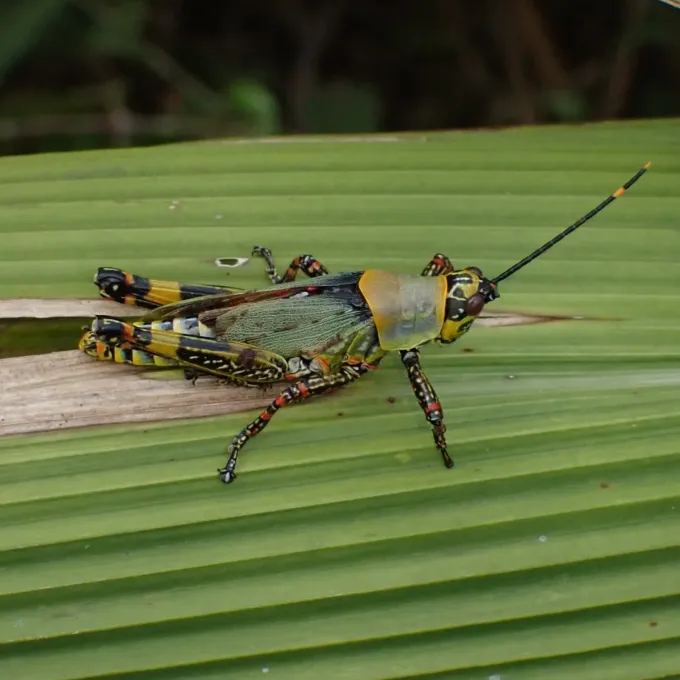
The variegated grasshopper, scientifically known as Zonocerus variegatus, belongs to the family Pyrgomorphidae within the order Orthoptera. It is a conspicuous insect, easily identified by its bright yellow, black, and red warning coloration, which signals its chemical defenses to potential predators.
Adults typically measure between 40 and 50 mm in length. The species exhibits sexual dimorphism, with females being significantly larger and more robust than males, which is a common trait within the group.
The life cycle involves five nymphal instars. Throughout these stages, the insects transition in appearance from black with white spots to vibrant yellow with black markings in their final adult form.
These insects possess specialized glands that secrete a foul-smelling, bitter-tasting fluid when disturbed. This adaptation effectively deters most birds and small mammalian predators in their native habitat.
Zonocerus variegatus is known for its gregarious nature, particularly during the nymphal stages. They often form dense, marching bands that can rapidly defoliate crops and localized vegetation.
What it damages
The variegated grasshopper is a polyphagous pest, meaning it feeds on a wide range of botanical hosts. Primary crops at risk include cassava, maize, cocoa, coffee, citrus, and oil palm.
Cassava is particularly vulnerable; severe infestations often lead to complete defoliation, resulting in significant yield losses of both leaves and tubers, which are staples in many regions.
The insects consume vegetative parts, including leaves, young buds, and succulent stems. Their feeding style is aggressive, often reducing leaves to mere remnants of the central midribs.
In woody crops like coffee and cocoa, the grasshoppers chew on fresh bark and growing tips, which can stunt tree development and reduce overall plant vigor for several successive seasons.
In addition to direct biomass loss, the feeding wounds provide entry points for secondary pathogens, such as bacteria and fungi, which can exacerbate the health decline of the host plants.
When it appears
The biological cycle of Zonocerus variegatus is strictly synchronized with rainfall patterns. Breeding and egg-laying occur during the start of the wet season.
Females deposit their eggs into the soil, where they may enter a period of diapause during the dry season, waiting for the humidity and temperature cues required for hatching.
Mass hatching of nymphs typically coincides with the first significant rains, which provide the lush vegetation necessary for their rapid growth and survival.
The number of generations per year depends on the local climate, with some regions experiencing one or two cycles, directly influencing the duration of the pest pressure on agriculture.
Peak activity is observed during the phase of most rapid crop growth, as young, nitrogen-rich foliage is the preferred food source for both nymphs and adults.
Signs of infestation
The most evident sign of an infestation is the presence of gregarious nymphal bands, moving across fields in large, highly visible clusters that consume green tissue systematically.
Leaves display characteristic damage patterns: irregular margins and extensive defoliation, with only the toughest vascular structures remaining attached to the stems.
Accumulation of frass (insect excrement) beneath the foliage canopy is a definitive indicator of a large colony that has been feeding on the plant for an extended period.
An unmistakable, pungent odor often permeates the air near dense colonies, resulting from the chemical secretions the grasshoppers release as a defense mechanism.
Wilting of terminal shoots and visible gnawing on bark or buds on young seedlings are critical indicators that the infestation is causing direct physiological harm to the crop.
Control measures
Management of the variegated grasshopper requires an integrated approach that focuses on early intervention and reducing the population before it reaches critical thresholds.
- Manual collection: Physically removing and destroying clusters of nymphs before they disperse across larger field areas.
- Cultural practices: Deep cultivation of the soil in documented egg-laying sites to disrupt and kill the subterranean eggs.
- Biological control: Utilizing entomopathogenic fungi such as Metarhizium anisopliae, which target grasshopper populations effectively in humid conditions.
- Chemical control: Targeted application of contact insecticides during the early nymphal stages, focusing on the perimeter of infested patches.
- Surveillance: Regular scouting of fields to identify breeding sites and nymphs early in the season to prevent wide-scale migration into commercial crops.
Taxonomy
- Latin name
- Zonocerus variegatus
- Order
- Orthoptera (locusts)
- Family
- Pyrgomorphidae
- EPPO code
- ZONCVA
Discussion
No discussions yet — be the first.