
Atractomorpha crenulata
Atractomorpha crenulata
Description
How to identify
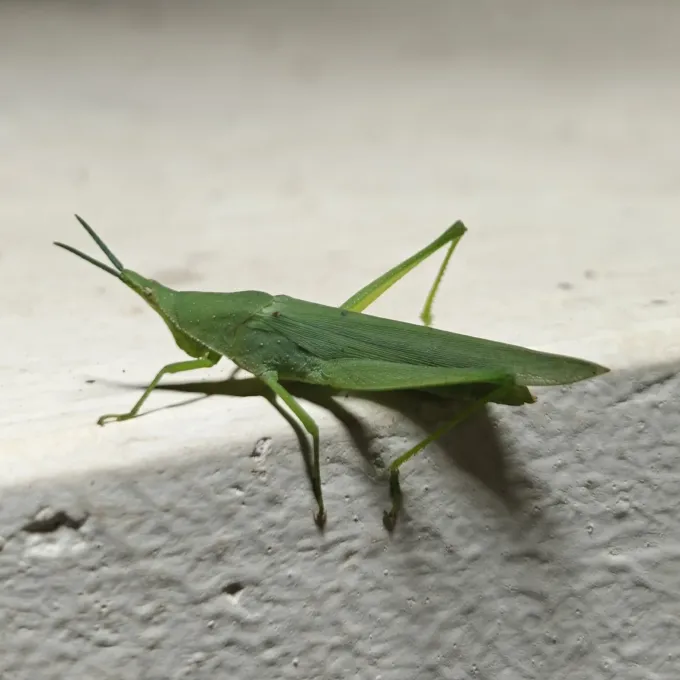
Atractomorpha crenulata belongs to the order Orthoptera and the family Pyrgomorphidae. It is easily recognized by its distinctively conical head, which sets it apart from common grasshoppers.
The coloration of this pest typically ranges from bright green to brown, providing excellent camouflage against leaves and stems. Adults generally grow between 20 and 40 millimeters in length.
Females are significantly larger than males, displaying sexual dimorphism common to the family. They possess well-developed wings, allowing them to migrate over considerable distances in search of food.
The biology of this species is highly dependent on warm temperatures. The life cycle involves egg, nymph, and adult stages, with nymphs passing through several instars before reaching maturity.
Eggs are deposited in the soil in protective pods, which ensure survival through unfavorable conditions and provide a reservoir for future infestations during the growing season.
What it damages
Atractomorpha crenulata is a polyphagous pest, meaning it feeds on a wide range of plants. It is particularly destructive in tropical and subtropical regions where it finds ideal conditions.
Cereal crops, including rice and corn, are frequent targets for this pest, often leading to substantial economic losses in infested agricultural areas worldwide.
Vegetable crops such as tomatoes, peppers, and eggplants are also highly susceptible, with feeding damage reducing both the quality and quantity of the vegetable yield.
Industrial crops like cotton are frequently damaged, as the grasshopper consumes tender shoots and leaves, which can severely stunt the growth of young plants.
Beyond crop fields, weeds serve as alternative hosts, allowing the population to build up in surrounding areas before moving onto cultivated crops.
Signs of infestation
The primary sign of infestation is irregular, notched edges on leaves. Unlike many larvae that consume leaves from the center, this pest prefers the edges, leaving a jagged pattern.
High population densities often result in leaf skeletonization, where only the tough veins remain. This significantly impacts the plant's ability to perform photosynthesis.
Adult grasshoppers are active during the day and are often visible while resting on the undersides of leaves or on stems, where they seek shelter from direct sunlight.
Damage to young seedlings can be fatal, especially when the pest destroys the growing tip, preventing the plant from developing properly or leading to total crop failure.
The presence of insect frass (droppings) on the leaves beneath the feeding sites is a clear indicator of recent activity and helps locate the pest during inspections.
Control measures
Cultural control is the most effective preventative measure. Keeping fields free of weeds and performing deep plowing disrupts the life cycle by destroying egg pods buried in the soil.
Biological control relies on encouraging natural predators such as birds and specialized insects that feed on nymphs, helping to maintain natural population balance.
If infestations reach critical thresholds, systemic or contact insecticides may be necessary. It is crucial to apply these during cool morning or evening hours to improve efficacy.
Monitoring population levels using pheromone or light traps allows farmers to intervene early, targeting hotspots before the pest spreads across the entire field.
Maintaining proper crop rotation and spatial isolation from non-crop areas can drastically reduce the risk of massive migrations into sensitive production zones.
Taxonomy
- Latin name
- Atractomorpha crenulata
- Order
- Orthoptera (locusts)
- Family
- Pyrgomorphidae
- EPPO code
- ATRCCU
Discussion
No discussions yet — be the first.