
Elegant grasshopper
Zonocerus elegans
Description
How to identify
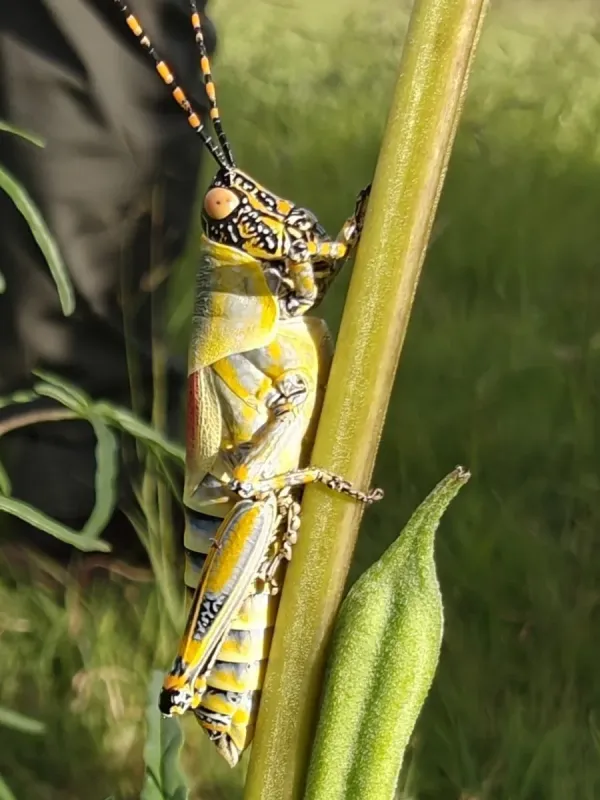
The elegant grasshopper (Zonocerus elegans) is a member of the Pyrgomorphidae family. It is known for its vivid color pattern, typically displaying a mix of bright yellow, green, and red, which acts as an aposematic signal to warn predators of its toxicity.
Adult insects measure between 35 and 45 mm in length. The nymphs pass through several growth stages, changing their coloration from predominantly black with yellow bands to the complex, bright patterns seen in mature specimens.
This species is largely ground-dwelling and prone to gregarious behavior, especially during the early nymphal stages. They often aggregate in large groups on vegetation or near the ground, which facilitates their detection.
The insect possesses chemical defense mechanisms, sequestering toxins from host plants. This makes them unpalatable to most vertebrates, allowing them to remain relatively undisturbed in their environment.
Belonging to the order Orthoptera, this species is widely distributed across sub-Saharan Africa. Its ability to adapt to various environmental conditions makes it a persistent agricultural pest in tropical and subtropical regions.
What it damages
The elegant grasshopper is a highly destructive polyphagous pest. Due to its broad diet and tendency to feed in large, concentrated swarms, it can cause devastating losses to a wide array of crops within a very short timeframe.
The list of host plants affected by this species is extensive:
- Cassava, which is particularly vulnerable
- Citrus orchards
- Coffee and cocoa plantations
- Cereal crops including maize and millet
- Various legumes and vegetable crops
Damage is characterized by aggressive defoliation, where the insects consume entire leaf blades, often leaving only the main veins. High-density infestations can result in the complete stripping of vegetation from the field.
In addition to leaf consumption, adults often feed on the bark of young shoots and stems, weakening the plant structure and making it susceptible to secondary infections or breakage under wind or fruit load.
Beyond direct crop loss, the toxicity of the insect tissues means that contaminated forage can be hazardous to livestock, leading to secondary economic losses for farmers who rely on local vegetation for feed.
When it appears
The life cycle of the elegant grasshopper is deeply synchronized with seasonal rainfall patterns. Eggs typically remain dormant in the soil during the dry season, waiting for the humidity of the rainy season to trigger development.
This egg-diapause strategy allows the species to survive prolonged periods of drought. Once the rains commence, the hatching of the nymphs begins, often occurring in synchronized waves.
The nymphal period lasts for several weeks, during which the insects are flightless and stay in close proximity to their hatching sites. This is the optimal window for targeted pest control measures.
Adults emerge as the rainy season progresses, reaching peak activity and reproductive maturity during the height of the growing season. This timing coincides with the availability of lush, green vegetation required for their feeding.
After mating and oviposition in the soil at the end of the rainy season, the adults die. The eggs remain in the ground, repeating the cycle in the following year if environmental conditions remain favorable.
Signs of infestation
The most prominent sign of infestation is the presence of large, conspicuous swarms of colorful nymphs or adults on host plants. These aggregations are easily visible and often indicate a high local population density.
Visual symptoms on plants include ragged leaf margins and large, irregular holes in the foliage. In severe cases, extensive defoliation leaves plants stunted and unproductive, with visible exposure of branches and stems.
Accumulation of dark, distinct frass (excrement) on the ground underneath host plants is a reliable indicator of active feeding by a large colony. This waste is often found in high concentrations in infested areas.
A peculiar, pungent odor is associated with dense populations of this grasshopper. Farmers often detect this smell before they see the insects, serving as an early warning for potential crop damage.
Wilting of terminal shoots and the physical collapse of young, succulent plants are clear indicators that the grasshopper infestation has reached a critical, damaging level necessitating immediate intervention.
Control measures
Effective management requires a multi-faceted approach. Mechanical control, such as the manual collection and destruction of egg-laying sites in the soil, can significantly reduce the population density if performed during the dry season.
Chemical control is most effective when applied to young nymphal stages, particularly while they are still clustered together and flightless. Targeted insecticide application can prevent the spread of the swarm.
Cultural practices, such as deep plowing of fields after harvest, help to destroy egg pods buried in the soil, preventing them from hatching in the subsequent season and disrupting the life cycle.
Biological control research continues, focusing on the use of entomopathogenic fungi to infect and reduce grasshopper populations. However, these methods are often slower and require specific environmental conditions to function optimally.
Regular monitoring of field edges and adjacent weed populations is vital, as these are often the starting points for infestations. Early identification allows for localized treatment, minimizing the need for broad-scale chemical application.
Taxonomy
- Latin name
- Zonocerus elegans
- Order
- Orthoptera (locusts)
- Family
- Pyrgomorphidae
- EPPO code
- ZONCEL
Discussion
No discussions yet — be the first.