
Zonocerus
Zonocerus
Description
How to identify
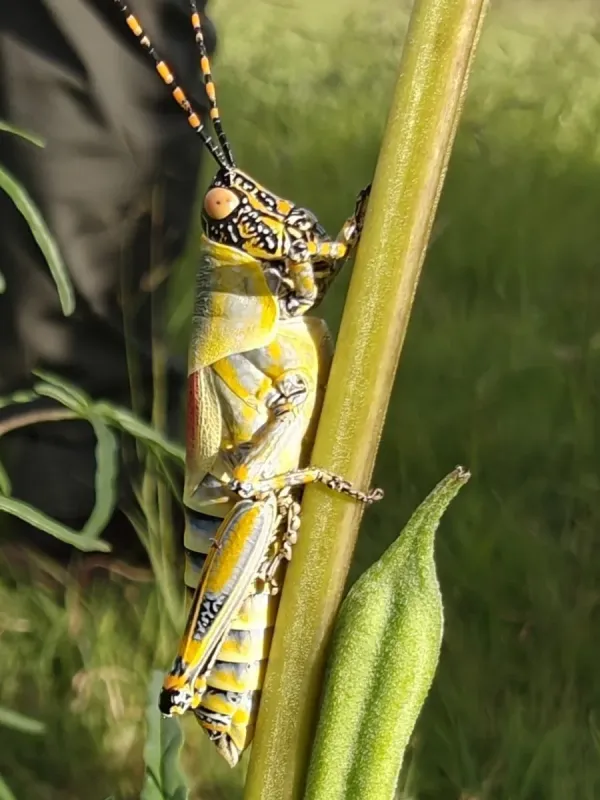
Zonocerus is a genus of insects belonging to the order Orthoptera and the family Pyrgomorphidae. These insects are easily recognized by their vivid warning coloration, often featuring bright yellow, black, and red stripes, indicating their toxicity to predators.
Adults possess strong hind legs for jumping and powerful mandibles capable of cutting through tough vegetation. Females are significantly larger than males and deposit eggs in soil in large, compact clusters, covered with a foamy secretion that hardens to protect them from desiccation.
The life cycle encompasses the egg stage, five nymphal instars, and the adult stage. The embryonic development of the eggs is highly dependent on soil moisture and can last several months during dry seasons.
Zonocerus nymphs often exhibit gregarious behavior in their early stages, forming dense clusters on host plants. This social structure aids in efficient feeding and provides communal defense against natural enemies.
Sexually mature adults are highly migratory, which allows them to expand their range rapidly. In many African regions, they are considered devastating pests, capable of destroying crops over vast areas.
What it damages
This pest is a polyphage, causing severe damage to a wide range of agricultural crops. Major targets include cassava, cocoa, coffee, maize, and various leguminous species.
On large plantations, Zonocerus can completely defoliate young trees, leading to stunted growth and significant reductions in yield potential.
Beyond direct consumption of leaves, the pest causes indirect damage by fouling plants with its excrement. This creates an environment conducive to the development of secondary fungal and bacterial diseases.
Mass infestations are particularly destructive, as the swarms move from one area to another, essentially stripping foliage from entire fields within a very short time frame.
The pest readily consumes weeds as well, allowing its population to persist in the field even after the main harvest is completed or during crop rotation cycles.
When it appears
The appearance of these insects is closely tied to rainfall cycles. Typically, nymphs begin hatching from the soil following the first significant rains after a prolonged dry season.
Population peaks usually coincide with the active growth phase of primary crops, when fresh, nutritious foliage is most abundant and accessible.
Depending on regional climatic conditions and food availability, the insect can complete one or two generations per year.
During dry spells, the insect enters a diapause state as an egg in the soil, which renders the population highly resilient to harsh environmental conditions.
Understanding the phenology of Zonocerus is critical for the timing of control interventions, as management is most effective when targeting early nymphal instars.
Signs of infestation
A primary sign of infestation is the presence of irregular, ragged leaf edges. Zonocerus typically feeds along the perimeter of the leaf, moving inward toward the petiole.
Early signs include clusters of small nymphs on the underside of leaves, which leave behind skeletonized patches of leaf tissue.
Accumulated excrement on leaves and the soil surface serves as a clear indicator of the pest's presence. In large colonies, this fouling becomes highly visible.
In cases of severe infestation, a distinctive chewing sound is audible, and plants appear significantly stressed and defoliated. Adults are frequently observed in dense groups on tree stems and branches.
Damage to terminal buds and growing points in young plants leads to stem twisting or complete arrest of plant development, easily identified during routine field inspections.
Control measures
Mechanical destruction is effective on smaller scales. Collecting and destroying egg masses in the soil during the dry season significantly reduces the population for the subsequent cycle.
- Application of bio-insecticides based on the fungus Metarhizium anisopliae.
- Use of contact and systemic insecticides during peak infestation levels.
- Routine weeding to remove host plants that serve as reservoirs for nymphs.
- Installation of insecticidal barrier strips around the perimeter of plantations.
Agronomic measures include deep plowing, which disturbs and destroys egg nests, exposing them to UV radiation and natural predators.
The use of traps with attractants has shown promise in monitoring population density and reducing the number of adult pests in targeted agricultural areas.
Taxonomy
- Latin name
- Zonocerus
- Order
- Orthoptera (locusts)
- Family
- Pyrgomorphidae
- EPPO code
- ZONCSP
Discussion
No discussions yet — be the first.