
Zoniopoda tarsata
Zoniopoda tarsata
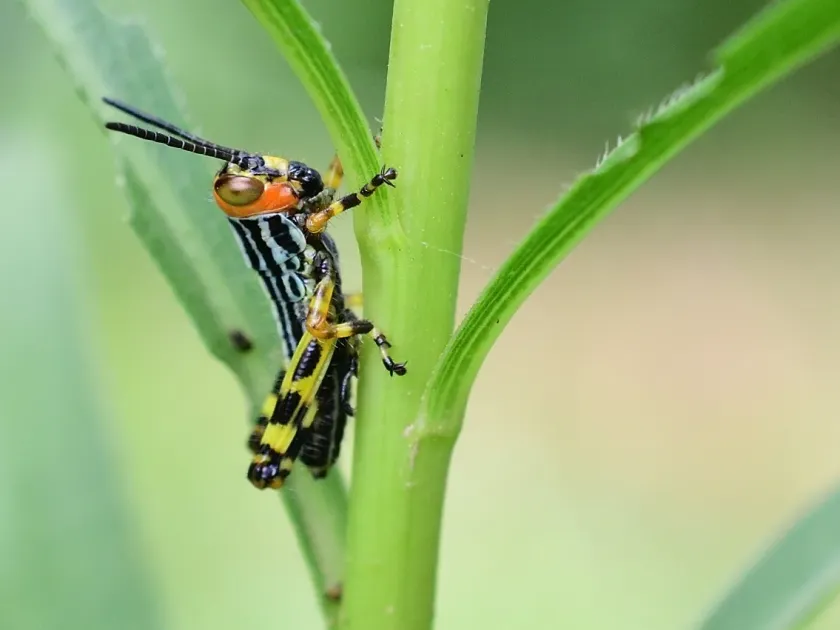
Description
How to identify
Zoniopoda tarsata is a grasshopper species belonging to the order Orthoptera and the family Romaleidae. These insects are easily recognized by their striking, often warning-colored bodies which signal chemical defense mechanisms.
The morphology of Zoniopoda tarsata includes a robust pronotum and powerful hind legs adapted for jumping. Their coloration typically features a combination of black, yellow, and red, serving as a biological warning to predators.
The life cycle follows a hemimetabolous development process. Nymphs (juveniles) resemble smaller versions of the adults, gradually developing wing pads as they undergo successive molts.
In the field, adults are characterized by their relatively large size and slow, deliberate movements unless disturbed, when they use their jumping ability to evade threats.
These insects are primarily found in neotropical environments, where they occupy various habitats ranging from grasslands to agricultural borders, depending on the availability of host plants.
What it damages
Zoniopoda tarsata is a polyphagous insect that feeds on a wide range of botanical species, making it a potential threat to diverse agricultural and horticultural crops.
The damage is primarily caused by both nymphs and adults feeding on leaves. They consume the leaf blade, often leaving only the primary veins, which significantly impairs the plant's photosynthetic capacity.
In addition to leaf consumption, they may cause damage to succulent stems, particularly in young plants, which can stunt development or lead to total loss of the seedling.
High population densities can lead to severe defoliation of entire fields, resulting in significant yield losses for cereal crops, legumes, and vegetable plantations.
Furthermore, the presence of these insects can facilitate the entry of pathogens into plant tissues due to mechanical injuries caused by their mandibles, leading to secondary infections.
When it appears
The seasonal occurrence of Zoniopoda tarsata is highly influenced by climatic conditions, with activity peaks typically aligning with the warmer months of the year.
Eggs are typically laid in the soil towards the end of the breeding season, remaining in a state of diapause through the cooler or dry months to survive unfavorable weather.
Nymphal emergence usually occurs at the onset of the spring or rainy season, coinciding with the rapid growth phase of various agricultural crops, which provides an abundant food source.
Adult populations peak during mid-to-late summer, where they exhibit the highest mobility and feeding intensity, actively seeking mates and favorable sites for egg deposition.
As temperatures decline or the dry season sets in, the population size naturally decreases, with the species persisting solely through the eggs remaining in the soil.
Signs of infestation
The most immediate sign of an infestation is the presence of irregular, ragged-edged holes appearing in the leaf canopy, often starting from the lower parts of the plant.
- Observation of brightly colored, distinctively shaped grasshoppers on leaves.
- Severe skeletonization of leaves, where only the midrib remains.
- Accumulation of granular frass on the soil surface or in leaf axils.
- Noticeable thinning of crop density in localized patches within the field.
Early scouting is essential, as these grasshoppers often aggregate in hotspots near field margins before spreading deeper into the crop during the later stages of their development.
Control measures
Controlling Zoniopoda tarsata requires an Integrated Pest Management (IPM) approach to maintain populations below economic thresholds while minimizing environmental impacts.
Cultural control practices, such as tillage and field edge cleaning, are effective for destroying egg pods in the soil, which helps prevent mass emergence in the following season.
Biological control methods involve the use of entomopathogenic fungi or natural predators, which can provide sustainable regulation of nymphal populations without chemical residues.
Chemical intervention should be reserved for threshold-based applications, preferably targeting the localized hotspots where insects first congregate, rather than broadcast spraying.
Monitoring efforts should focus on identifying early-stage nymphs at the field edges, as timely action at this stage can prevent widespread migration and limit potential crop damage.
Taxonomy
- Latin name
- Zoniopoda tarsata
- Order
- Orthoptera (locusts)
- Family
- Romaleidae
- EPPO code
- ZONPTA
Discussion
No discussions yet — be the first.