
Eastern lubber grasshopper
Romalea microptera
Description
How to identify
The Eastern lubber grasshopper (Romalea microptera) is a large, flightless insect belonging to the family Romaleidae. Adults can reach lengths of 7 to 8 cm and possess heavy bodies with vibrant coloration patterns, ranging from yellow and orange to near-black.
Due to their reduced wings, they are unable to fly, which limits their dispersal distance but makes them highly sedentary foragers within their chosen habitat.
They are famous for their chemical defense mechanism: when threatened, they hiss and spray a foul-smelling, irritating foam, which effectively deters many predators.
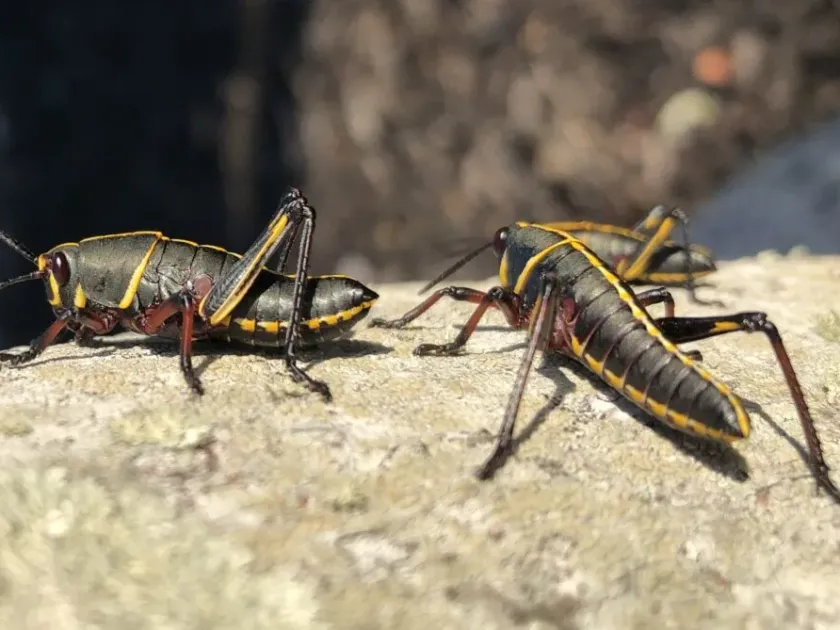
The life cycle involves an egg stage that overwinters in the soil, followed by five nymphal instars. Nymphs often exhibit distinctive black coloration with yellow or orange stripes.
These grasshoppers thrive in warm climates and are commonly found in meadows, open fields, and along roadsides where succulent vegetation is abundant.
What it damages
As generalist feeders, Eastern lubber grasshoppers consume a wide array of plants, including ornamental flowers, vegetables, shrubs, and even young trees.
They can cause severe damage by stripping leaves, flowers, and tender stems, often leaving behind only the veins of the foliage.
In garden settings, they can rapidly defoliate ornamentals and vegetable crops, resulting in stunted growth or the total death of young seedlings.
Beyond physical consumption, their feces can cause aesthetic damage and may introduce pathogens to the already wounded plant tissues.
Large outbreaks often occur when environmental conditions are ideal, leading to mass movements from peripheral habitats into cultivated garden plots.
Signs of infestation
The most obvious sign of an infestation is the presence of large, brightly colored adults resting on plants during the day.
Look for ragged, torn leaf edges and stems that have been chewed down to the main stalks, which are characteristic signs of their voracious appetite.
Accumulated dark fecal droppings on leaves or on the ground beneath damaged plants are clear indicators of a high population density.
Groups of smaller, black-colored nymphs congregating on a single host plant indicate an early-stage colony that requires immediate management.
Sudden damage to buds and terminal growth in shrubs often points to active feeding by these large insects.
Control measures
Hand-picking is the most effective method for small-scale gardens. Collecting them early in the morning, when they are less active, is highly recommended.
Targeted application of insecticides can be effective against young nymphs, which are more susceptible to chemical treatments than mature adults.
Cultural control practices include keeping the perimeter of the garden clear of weeds and high grass to minimize suitable breeding sites.
Tilling the soil in late fall or winter can help destroy egg pods buried in the ground, significantly reducing the hatching population in the spring.
- Regular monitoring of vegetation.
- Removing debris and weeds around crops.
- Using row covers for young vegetable seedlings.
Taxonomy
- Latin name
- Romalea microptera
- Order
- Orthoptera (locusts)
- Family
- Romaleidae
- EPPO code
- ROMAMI
Discussion
No discussions yet — be the first.