
Giant red-winged locust
Tropidacris collaris
Description
How to identify
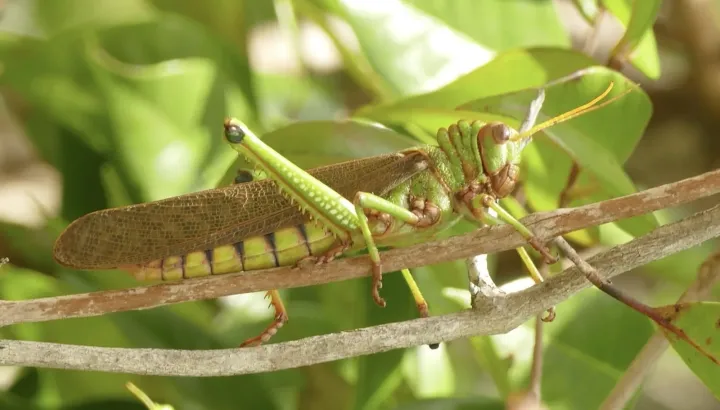
Tropidacris collaris belongs to the family Romaleidae (lubber grasshoppers). It is one of the largest orthopteran species in the world, with adult body lengths often exceeding 12–15 centimeters.
The appearance of adults is characterized by vivid coloring: the forewings have a greenish tint with a reticulated pattern, while the hindwings are frequently colored in intense red or pink, which is striking during flight.
Nymphs vary in coloration throughout their development, transitioning from yellowish to dark, almost black hues with yellow spots, acting as a warning signal to predators.
This species is generally solitary, yet during outbreaks, it can demonstrate gregarious behavior, forming local groups that cause significant damage to vegetation.
The distribution range covers mainly South American countries, including Brazil, Argentina, and Paraguay, where climatic conditions are highly favorable for these large grasshoppers.
What it damages
Tropidacris collaris is a polyphagous pest, meaning it has the ability to feed on a wide variety of plant species rather than being restricted to a single host crop.
Primary target crops include both wild species and valuable agricultural plants such as citrus trees, bananas, cocoa, coffee, and corn.
The pest poses a particular threat to young plantations, as insects can completely devour leaves, leaving only tough veins, which leads to critical weakening of the plant.
Beyond leaf consumption, adults often damage young shoots and tree bark, which triggers the development of secondary fungal and bacterial infections in the wound sites.
The level of harm significantly increases during local population spikes when thousands of individuals can destroy a substantial portion of green biomass in just a few days.
When it appears
The biology of this species is closely linked to rainfall patterns. The peak activity of adults usually occurs during the summer, when tropical regions experience consistently high temperatures.
The life cycle includes an egg stage, where eggs are deposited in the soil. Embryonic development can be delayed if soil moisture is insufficient for metabolic activation.
Nymphs emerge at the beginning of the rainy season, when fresh vegetation provides the necessary nutrition for rapid growth and subsequent molting stages.
Maturation from the first larval stage to an adult takes several months, depending on the temperature regime and the availability of food sources in the specific region.
Adults live for several months, actively mating and dispersing to new territories in search of optimal conditions for laying the next generation of eggs.
Signs of infestation
The primary sign of the pest's presence is the occurrence of large, ragged holes in leaf blades, which clearly indicate the work of powerful mandibles.
During visual inspections of plantations, one can often find insect excrement, which is easily distinguished from that of smaller pests due to its specific size and shape.
Mass clusters of nymphs on bushes or lower tree tiers indicate the initial stage of area infestation, which requires immediate attention to prevent wider spread.
Damage to shoots is often accompanied by sap flow, which attracts other insects and creates a favorable environment for pathogens, causing wilting in parts of the plant.
In the early morning hours, when the locusts are less active due to cooler temperatures, adults can easily be spotted sitting on branches, proving the threat to the harvest.
Control measures
Effective protection against Tropidacris collaris requires a multi-faceted approach, combining mechanical, biological, and chemical methods of control.
Mechanical control consists of manual collection of nymphs in small areas, which is effective when spotting initial infestation hotspots.
Biological control relies on the use of natural predators, such as insectivorous birds or entomopathogenic fungi, which limit population numbers in their natural habitat.
Chemical treatment with broad-spectrum insecticides is reserved for cases of massive outbreaks, requiring careful dosage management to avoid upsetting the ecological balance.
- Population monitoring using light traps;
- Timely removal of weeds that serve as alternative hosts;
- Application of Metarhizium-based biological pesticides to target nymphs.
Taxonomy
- Latin name
- Tropidacris collaris
- Order
- Orthoptera (locusts)
- Family
- Romaleidae
- EPPO code
- TRODCO
Discussion
No discussions yet — be the first.