
Eastern lubber grasshopper
Romalea
Description
How to identify
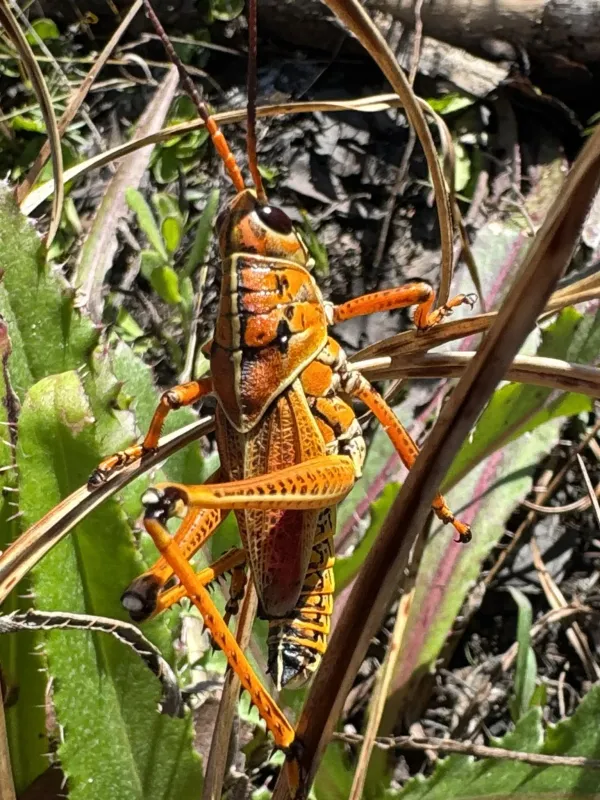
The Eastern lubber grasshopper (Romalea microptera) is a prominent member of the Romaleidae family within the order Orthoptera, known for its large size and distinct appearance.
Adults are easily recognized by their bulky bodies, which can reach up to 8 centimeters in length, and their vibrant color patterns, often displaying yellow, orange, and black.
These insects possess short, non-functional wings, which means they are flightless and rely primarily on walking or jumping to move between food sources.
The grasshopper has a very robust set of mandibles capable of consuming thick leaves, stems, and even the flowers of various garden and field plant species.
Juvenile stages, or nymphs, are typically jet black with bright yellow or red stripes, serving as a visual warning to potential predators in their environment.
What it damages
As a generalist herbivore, the Eastern lubber grasshopper feeds on a wide range of plants, including many ornamental species, vegetables, and broadleaf crops.
They are particularly fond of plants in the lily, amaryllis, and citrus families, causing significant damage to leaves, buds, and fruit by stripping them entirely.
In home gardens, high populations can quickly defoliate shrubs and flower beds, leading to stunted growth or the complete death of the affected plants.
Beyond the physical destruction of plant tissues, the presence of their frass (excrement) can foster the development of bacterial and fungal pathogens.
Their sheer appetite and tendency to feed in groups make them a formidable pest in localized areas, especially where mechanical control is not implemented.
When it appears
The species completes a single generation per year, with the vast majority of its life cycle spent as an egg embedded within the soil profile.
Eggs typically hatch in the spring once soil temperatures have risen sufficiently, allowing the young nymphs to emerge and begin feeding immediately.
Throughout the late spring and summer months, the nymphs go through several molting stages, steadily increasing in size and feeding intensity.
Adults emerge by mid-summer and remain highly active throughout the warmest months, continuing to feed and eventually mating in late summer or early autumn.
Following mating, females deposit their eggs in underground pods, which serve as a protective state during the winter months until the cycle restarts.
Signs of infestation
Significant, ragged holes in leaves and the complete consumption of foliage are the most prominent indicators of a lubber grasshopper infestation.
The physical presence of these colorful, slow-moving insects on plants during the day is the most direct sign of their activity in the area.
Large amounts of dark-colored fecal pellets concentrated near the base of plants are reliable indicators of heavy feeding activity by a group of grasshoppers.
The destruction of flower buds or the sudden disappearance of seedlings overnight often suggests the presence of these hungry pests in the immediate vicinity.
In areas with high grass density, the distinct sound of movement and the visual spectacle of their bright bodies make them easy to detect during inspections.
Control measures
Manual removal is the most effective and eco-friendly control method for small-scale gardens; simply pick the grasshoppers off the plants and dispose of them.
If chemical control is necessary, applying insecticides early in the season while the nymphs are still small provides the highest level of success.
Cultivating and tilling the soil in the fall and early spring can help destroy egg pods located near the surface, reducing the population for the next year.
Creating physical barriers, such as fine-mesh netting, can protect high-value plants or vegetable patches from being accessed by the flightless insects.
Maintaining a clean garden by removing excessive weeds helps reduce the initial food supply, making the area less attractive for early-stage nymph development.
Taxonomy
- Latin name
- Romalea
- Order
- Orthoptera (locusts)
- Family
- Romaleidae
- EPPO code
- ROMASP
Discussion
No discussions yet — be the first.