
Zoniopoda iheringi
Zoniopoda iheringi
Description
How to identify
Zoniopoda iheringi belongs to the order Orthoptera and the family Romaleidae. This insect has a distinctive appearance that aids in its identification within agricultural settings.
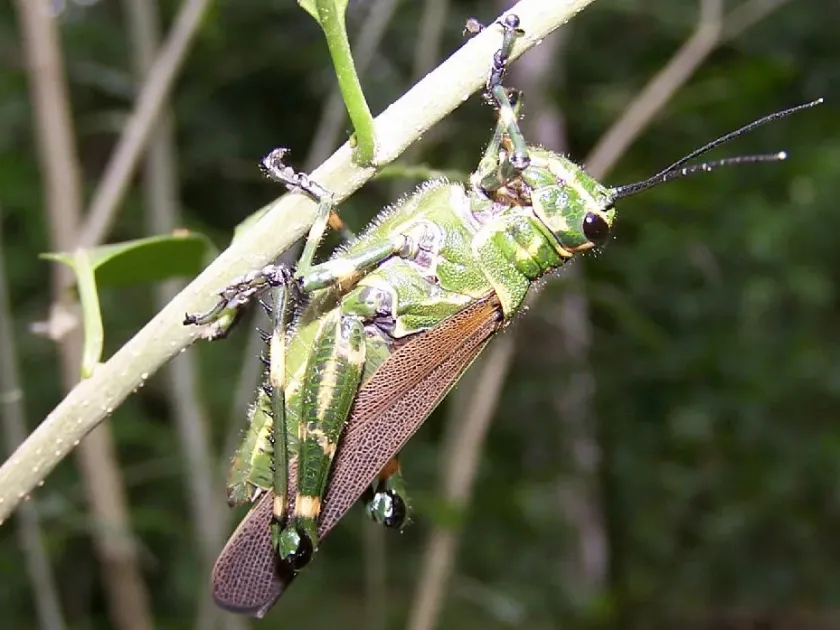
Adult individuals possess a bright coloration, often combining black, yellow, and red hues, which serves as a warning signal to predators. The body is robust, and the adult insect can reach significant sizes for its family.
Nymphs (larvae) also exhibit distinct coloration that changes as they mature while retaining vibrant stripes or spots. This makes them easy to distinguish from other grasshopper species in the same region.
Key identification features include the structure of the pronotum and hind legs, which are characteristic of the Zoniopoda genus. The insect prefers open areas with abundant vegetation.
This species is a typical representative of South American entomofauna, so its discovery outside its natural range requires immediate control by phytosanitary authorities.
What it damages
This species is a polyphage, meaning it can damage a wide range of plants. It causes significant harm to agricultural lands by feeding on green foliage.
The main food sources include vegetable crops, various ornamental plants, and field grasses. Both adults and nymphs cause damage with their chewing mouthparts.
During mass outbreaks, the pest can destroy a large portion of crops in a short time. Plants suffer from total or partial defoliation of leaves and shoots.
Damage to the leaf blade leads to a decrease in photosynthetic activity, which inevitably affects crop yield and the quality of the harvested product.
It poses a particular threat to young seedlings and sprouts, which can be destroyed if significant damage occurs to the aerial parts.
When it appears
The activity of Zoniopoda iheringi depends directly on the temperature and air humidity typical of subtropical and tropical climate zones.
The life cycle includes several stages: egg, several nymphal instars, and adult. Eggs are laid in the soil, where they survive adverse conditions until the warm season begins.
The hatching of nymphs is usually timed to coincide with the active growing period of most agricultural crops, providing them with a high food supply.
The peak population density is observed during summer months when stable, warm weather facilitates rapid development of nymphs and the emergence of adults.
Monitoring the population should begin in early spring by conducting regular inspections of field margins and weed-infested areas where the pests may concentrate.
Signs of infestation
The primary sign of the pest's presence is the presence of coarsely chewed leaf edges and holes in the leaf blades.
In the early stages of infestation, one can notice clusters of bright nymphs on plant stems, especially during morning and evening hours when the insects are most active.
The presence of large amounts of excrement on the leaf surface and beneath plants is also an indicator of the pest's intensive feeding.
In areas of mass congregation, a change in the overall health of the plantings is observed: growth suppression, wilting of damaged leaves, and general plant stress.
Sometimes, specific damage to apical growth points can be observed, leading to stem deformation and disruption of proper crop development.
Control measures
Control of Zoniopoda iheringi is based on an integrated approach, including agrotechnical, biological, and chemical protection methods.
- Deep plowing of soil to destroy egg pods in overwintering sites.
- Removal of weeds along field borders that serve as reservoirs for the population.
- Use of contact-stomach insecticides when the economic threshold is exceeded.
- Encouraging natural entomophages, such as birds and predatory insects, in the area.
- Monitoring using yellow sticky traps to assess population dynamics.
The use of chemical agents must be strictly regulated to avoid harming beneficial pollinators and to prevent pesticide residue accumulation.
It is recommended to rotate products from different chemical groups to prevent the development of resistance in the pest, which is critical for long-term population management.
Preventive treatments should be carried out during periods of mass nymph hatching, as they are most sensitive to insecticidal control at that stage.
Taxonomy
- Latin name
- Zoniopoda iheringi
- Order
- Orthoptera (locusts)
- Family
- Romaleidae
- EPPO code
- ZONPIH
Discussion
No discussions yet — be the first.