
Zerynthia rumina
Zerynthia rumina
Description
How to identify
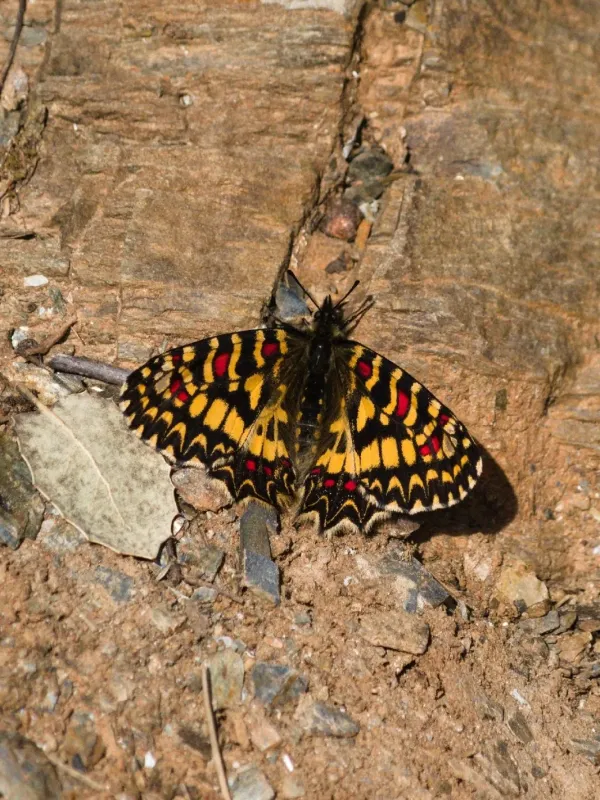
Zerynthia rumina, commonly known as the Spanish festoon, is a butterfly species belonging to the Papilionidae family. It is a visually distinct insect characterized by a bright pattern of yellow, black, and red markings on its wings.
The larvae, or caterpillars, of Zerynthia rumina possess a unique appearance with fleshy protuberances covering their bodies. Their coloration is typically cryptic, varying between shades of yellow and brown, which serves as a defense mechanism against avian predators.
Pupae of this species are notable for their angular structure and ability to attach themselves firmly to host plant stems using silk threads. This attachment is crucial for their survival during the prolonged diapause stage.
The eggs are laid individually or in small clusters on the undersides of leaves. Their smooth texture and pale color make them difficult to spot during routine garden inspections, necessitating careful monitoring.
Adult butterflies exhibit a wingspan of approximately 50 to 60 millimeters. While both sexes share similar markings, the intensity of the red spots can vary, reflecting genetic diversity and environmental factors of their respective habitats.
What it damages
The primary food source for Zerynthia rumina larvae is plants within the genus Aristolochia. In horticultural settings, these larvae can cause localized damage to ornamental species, particularly vines and creeping types.
Feeding activity is focused on the leaf blades, where the larvae utilize their mandibles to consume tissue. Heavy feeding can lead to skeletonization, leaving only the central veins, which significantly impairs the plant's photosynthetic capabilities.
Beyond leaves, larvae may target developing buds and tender shoots. This disruption can alter the plant's growth pattern and suppress flowering, which is particularly undesirable in landscape design and garden cultivation.
The severity of the damage is often proportional to the density of the larval population. In controlled garden environments, even a moderate infestation can lead to noticeable aesthetic degradation of the host plants.
Secondary infections often manifest in the damaged tissues, as the open wounds created by the larvae provide an entry point for various plant pathogens, further stressing the host plant's health.
When it appears
Zerynthia rumina follows a distinct seasonal cycle, generally exhibiting a single generation per year. The adult butterflies emerge in early spring, coinciding with the warming temperatures and the onset of plant growth.
The egg-laying phase occurs shortly after mating, typically when the host plants have developed sufficient foliage to support the developing larvae. The embryonic stage is temperature-dependent and relatively short.
Larval development occurs throughout the late spring and early summer. During this timeframe, the caterpillars are most active and responsible for the majority of the damage observed in horticultural settings.
Pupation generally takes place by early summer. The pupae enter a state of dormancy, remaining attached to the host plant or nearby structures to withstand the summer drought and winter conditions.
This phenology limits the period of active pest presence, allowing gardeners to focus their management efforts on specific windows in the spring and early summer months.
Signs of infestation
Visual identification starts with the presence of uneven, ragged margins on the leaves of Aristolochia species. These bite marks are characteristic of the larvae’s feeding habit and are often the first sign of an infestation.
The accumulation of frass, or larval excrement, beneath the feeding sites is a reliable indicator of the presence of older larvae that may be concealed among the foliage or stems.
Defoliated sections of stems and branches are clear signs of mature larval feeding. Once a section of the plant is depleted, the caterpillars will migrate to healthier leaves, spreading the impact of the infestation.
The presence of pupae fixed to the stems is a terminal indicator of the current season's pest cycle. These structures should be monitored if local populations are known to be high.
Stunted growth or wilting of individual branches can occur when feeding is localized on specific nodes, indicating that the larval activity is disrupting the plant’s nutrient transport system.
Control measures
Manual removal of caterpillars is a highly effective and non-toxic method for managing small-scale infestations in private gardens. This is best accomplished during the cooler hours of the morning or evening.
Biological control using Bacillus thuringiensis (Bt) represents an effective intervention. This bacteria specifically targets caterpillar digestive systems while remaining safe for beneficial insects, pollinators, and the environment.
Maintaining vigorous plant health through appropriate irrigation and nutrient management ensures that plants have the resilience to withstand minimal herbivory without succumbing to disease or structural damage.
In cases of severe infestation, targeted application of environmentally sensitive insecticides can be employed. Always ensure that the chosen product is labeled for use on ornamental plants and follow label directions.
- Regular monitoring of host plants
- Physical removal of larvae
- Deployment of biological Bt treatments
- Maintaining healthy plant soil conditions
- Clearing surrounding host debris
Taxonomy
- Latin name
- Zerynthia rumina
- Order
- Lepidoptera (butterflies)
- Family
- Papilionidae
- EPPO code
- ZERYRU
Discussion
No discussions yet — be the first.